C H O F MINISTRY™ · DID YOU KNOW?
God Restored What a Borrower Could Not Return
When a working member of the prophets' community lost borrowed iron in the Jordan, his crisis involved another man's property. Through Elisha, God restored the iron to the borrower's reach, making return possible. This account directs our attention beyond floating metal to entrusted responsibility: honest disclosure, the precise place of loss, and the obedience required when help arrives.
2 Kings 6:1–7 · Read alongside 2 Kings 4:1–7; Exodus 22:14–15; Deuteronomy 11:4
Bishop W. F. Houston Jr. ·
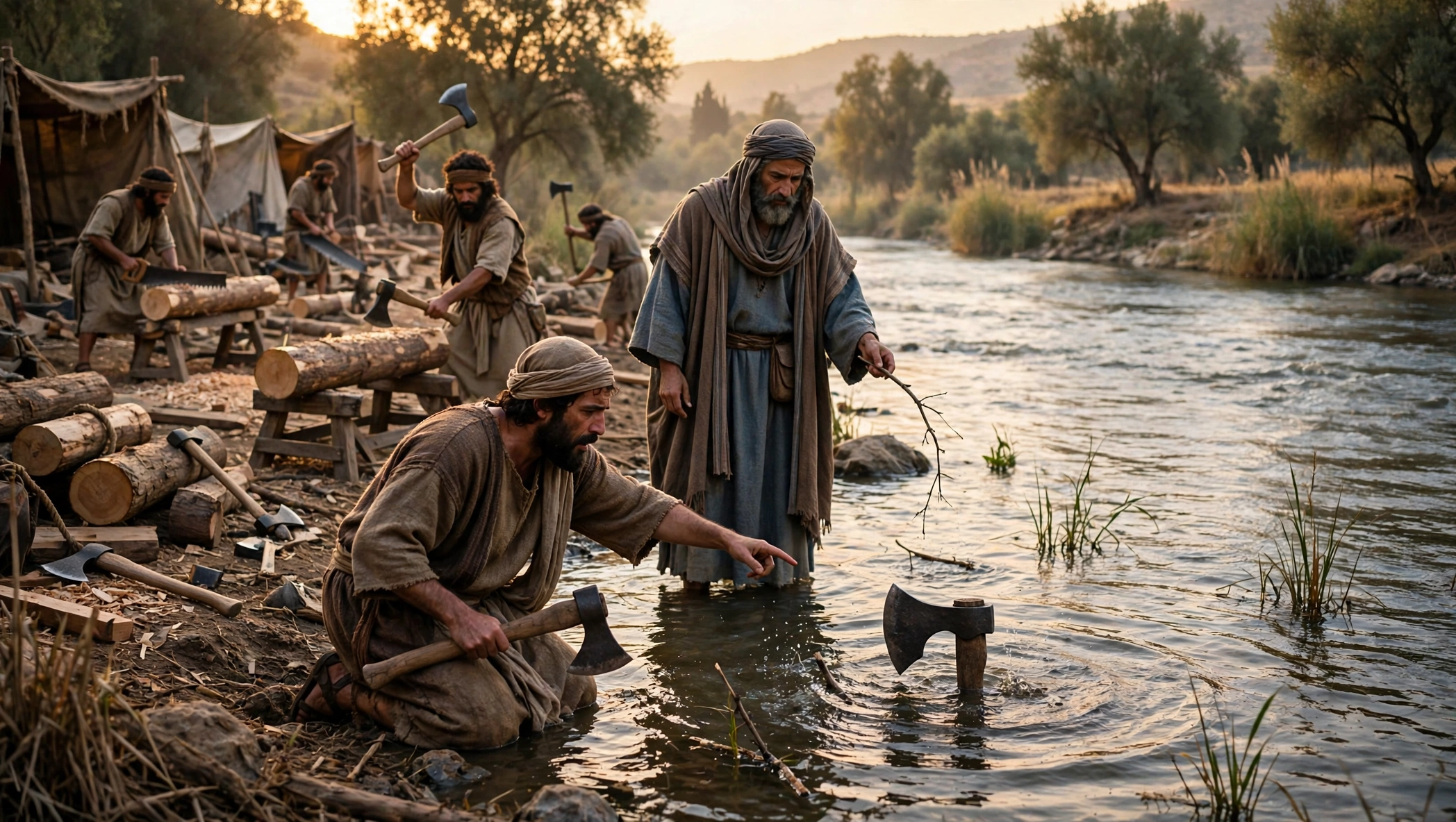
The discovery: Another man's property
Beloved, the surprising thing is not only that iron floated. It is that the recovered iron belonged to somebody else.
We can become so absorbed in the extraordinary event that we overlook the ordinary obligation. The worker's distress concerns borrowed property. A teaching centered entirely on getting our own possessions back misses the relationship at stake.
The discovery is this: God's provision through Elisha restored a borrower's ability to fulfill an obligation to another person. The narrative ends with retrieval, not a recorded meeting with the lender. Return became possible; the actual return is not narrated.
The passage gives no purchase price, income statement, or proof that the borrower was destitute. His obligation is explicit. His financial circumstances are not.
The question confronting us is therefore sharper than whether we want something restored: What do we owe to the person who trusted us with it?
Begin with the setting: Room to grow, work to do
The prophetic community's accommodation is inadequate. Its members propose going to the Jordan, where each can obtain timber for a larger dwelling. Elisha authorizes the work (vv. 1–2).
The crowded quarters suggest a growing community; the explicit fact is insufficient space. The proposed response is shared labor. Each person will contribute to the construction.
Their spiritual vocation does not remove the need for shelter, planning, tools, and effort. They identify the problem and undertake the work.
This matters for ministry. Expansion creates responsibilities, not exemptions. A worthy purpose does not make materials free, equipment ownerless, or borrowed resources expendable.
The loss occurs during legitimate work. Scripture does not accuse this borrower of carelessness or rebellion. Do not manufacture a sin to make the sermon easier to preach.
The account already contains sufficient weight: a good undertaking encounters a real difficulty, and another person's property is involved.
Read closely: The invitation before the emergency
Before the accident, one member asks Elisha to accompany them. Elisha answers, "I will go" (v. 3, ESV). Verse 4 records that he does.
The invitation belongs in the teaching. Elisha is at the work site because someone asked him to come. The prophet is present before the emergency, not introduced after the loss.
This is a connection within the narrative, not a mechanism for compelling miracles. The passage does not say that inviting a minister guarantees supernatural protection.
Its sequence nevertheless confronts our habits. Do we welcome godly counsel into the work itself, or seek it only after something goes wrong?
Do not reserve dependence on God for situations your competence can no longer manage. Bring the planning, the borrowing, and the handling of other people's resources under the truth you profess.
The man who requests Elisha's company and the man who loses the iron are not explicitly identified as the same person. We need no invented identity to recognize the importance of that invitation.
Original-language word study: Iron, borrowing, and floating
Pronunciation guide: simplified modern Israeli-style pronunciation of biblical Hebrew. Hyphens separate syllables; capitals mark stress. These are English reading aids, not reconstructions of ancient pronunciation.
Barzel — בַּרְזֶל — bar-ZEL
This noun means iron. In verses 5–6, the Hebrew identifies the material. The ESV's "axe head" in verse 5 identifies its function from the timber-cutting context; it does not translate a separate Hebrew noun meaning axe.
That concrete wording matters. Real iron was lost and recovered. The word itself does not mean a person's spiritual gift, calling, or effectiveness. Such associations are not lexical discoveries.
Sha'ul — שָׁאוּל — shah-OOL
This is the form in verse 5: a Qal passive participle of sha'al, meaning to ask or request. Here it describes something asked for and received for temporary use: borrowed property.
The same root appears in the borrowing law of Exodus 22:14. The connection concerns borrowing, not a hidden meaning embedded in the letters.
Trust is the relational implication of lending, not an additional dictionary definition of sha'ul. Someone had allowed this worker to use what remained that person's possession.
The owner is absent from the scene, but not from the obligation.
Tsuph — צוּף — TSOOF
This rare verb concerns flowing, overflowing, or floating according to context. In verse 6, the form is וַיָּצֶף, vayyatsef, pronounced vai-YA-tsef. It is Hiphil, a verbal form that here expresses causation: he caused the iron to float.
Elisha is the grammatical actor. The verb describes what he caused to happen; it does not explain the physical mechanism.
BDB also identifies a Hiphil occurrence in Deuteronomy 11:4. That is a shared verb, not evidence by itself that the two events form a prophetic pattern.
Together, these words keep the exposition accountable: the material was iron, its status was borrowed, and its recovery involved extraordinary action.
Tell the truth before you defend yourself
When the iron falls, the borrower immediately cries out to Elisha and identifies the fact that makes the loss especially serious: "It was borrowed" (v. 5, ESV).
He does not conceal the event. He does not describe another man's property as though it were his own to write off.
This is an acknowledgment of loss, not a confession of a sin the narrator has never charged. That distinction protects the man from false accusation while preserving the force of his honesty.
Now bring the principle home.
When entrusted property is lost or damaged, tell the truth. Do not wait until someone discovers the problem. Do not make the owner investigate what you already know.
An accident and a cover-up are different moral events. The first can happen without wrongdoing. The second adds deliberate deception.
Religious service does not excuse concealment. Using borrowed equipment for a worthy cause does not give you permission to keep its owner uninformed.
Name the place where the loss occurred
Elisha asks, "Where did it fall?" The worker shows him the location (v. 6, ESV).
The question is geographical before it is anything else. Elisha asks where the iron entered the water, not where the man lost his anointing.
Yet the exchange supports a disciplined application: deal with the actual loss, not a convenient generalization.
When a ministry account does not reconcile, identify the unexplained transaction. When borrowed equipment is damaged, identify the damage. When an obligation remains unmet, name the person affected and the commitment still outstanding.
Vague language can protect the speaker while leaving the injured party without an answer.
Saying that things became complicated is not the same as explaining what happened. Describing yourself as overwhelmed does not identify whose property is missing.
Precision is not cruelty. It gives responsible action a definite object.
Where the facts establish sin, name the sin and repent. Where they establish an accident, report the accident without inventing guilt. In either case, refuse concealment.
The worker points to a place. Let that concrete action challenge every attempt to hide an accountable fact inside an impressive explanation.
Receive the restoration with your own hand
Elisha cuts a stick, casts it into the identified place, and the iron floats. He then commands, "Take it up" (vv. 6–7, ESV).
The worker reaches out and retrieves it.
The passage assigns no independent power to the stick. It supplies no ritual for reproducing the event. God's extraordinary provision through Elisha brings the iron within reach; the borrower's hand receives it.
His action does not produce the miracle. It responds to what has been done.
That distinction exposes two errors: imagining that human effort controls divine power, and imagining that divine help makes human obedience unnecessary.
The restored object remains borrowed. Its recovery does not change its owner.
Here is the ethical force of the ending: relief from the immediate crisis restores the possibility of responsible action. The borrower can now return what he had been unable to retrieve.
Do not celebrate a recovered resource while ignoring the obligation attached to it. Gratitude must reach beyond astonishment into conduct.
Read the recovery within the larger biblical witness
The closest parallel is 2 Kings 4:1–7. A widow connected to the prophetic community faces a creditor threatening to take her children into slavery. Through Elisha's instructions and the provision of oil, she receives the means to address the debt and sustain her household. Elisha directs her to sell the oil and pay what she owes.
The provision does not make repayment irrelevant. It makes repayment possible. That is the strongest connection with the borrowed iron: divine help serves an obligation rather than erasing its moral significance.
Exodus 22:14 addresses liability when a borrowed animal is injured or dies while its owner is absent. Verse 15 supplies qualifications. This law is not a narrated legal judgment against the axe borrower; it establishes that borrowing in Israel carried defined responsibilities.
Deuteronomy 11:4 recalls God overwhelming Egypt's pursuing forces with water. Its connection here is linguistic: the same Hebrew verb occurs in the Hiphil, with a different contextual sense. Shared vocabulary does not authorize us to turn the axe into a symbol of the Egyptian army.
Read the passages together without making them say the same thing.
Bring the discovery into the work in your hands
What is presently in your possession that still belongs to someone else?
Begin there. Not with a list of things you want God to restore to you, but with the things another person has entrusted to your care.
Examine the borrowed tool, the entrusted funds, the equipment assigned to your ministry. Identify any unresolved loss. Contact the person affected. Establish the facts and address the obligation.
Where you have concealed damage, withheld information, or treated another person's property as expendable, repent. An explanation is not repentance when it leaves the conduct unchanged.
Ask God for help without dictating the form that help must take. This miracle is not a promise that every lost possession will return or every debt will disappear.
The borrower's crisis concerned more than an object beneath the water. It concerned a responsibility that could not be dismissed because recovery was difficult.
Do not use spiritual language to make someone else carry the cost of your dishonesty.
Let Us Go Into The Throne Room Of Grace And Mercy™
Father, expose the excuses we use to avoid accountability. Forgive our dishonesty, our concealment, and our disregard for what belongs to others.
Teach us to report losses truthfully, seek help without evasion, and obey when responsible action becomes possible. Keep us from confusing Your mercy with permission to neglect our obligations.
Where we must make restitution, give us willingness to act and wisdom to proceed faithfully. Let our gratitude be visible in what we do with the resources placed in our hands.
We ask in the name of Jesus Christ.
TO GOD BE THE GLORY!
Carry the discovery into your life.
Identify one unresolved obligation involving something entrusted to you. Write down whose it is, what happened, and the next honest action required. Then take that action. The question is not only what you hope to recover. It is what you remain responsible to return.
Sources for further examination
- 2 Kings 6 — English Standard Version
- 2 Kings 4 — English Standard Version
- Exodus 22 — English Standard Version
- Deuteronomy 11 — English Standard Version
- Brown–Driver–Briggs Hebrew lexicon: iron (barzel)
- Brown–Driver–Briggs Hebrew lexicon: ask / borrow (sha'al)
- Brown–Driver–Briggs Hebrew lexicon: float / overflow (tsuph)