C H O F MINISTRY™ · DID YOU KNOW?
God’s Spirit Equipped People to Design and Build
Exodus 31 places knowledge, understanding, design, and skilled craftsmanship within a sacred commission. Follow the passage into its setting, its language, and the responsibilities that accompany ability.
Exodus 31:1–11 · Read alongside Exodus 25:8–9; 35:30–36:7
Bishop W. F. Houston Jr. ·
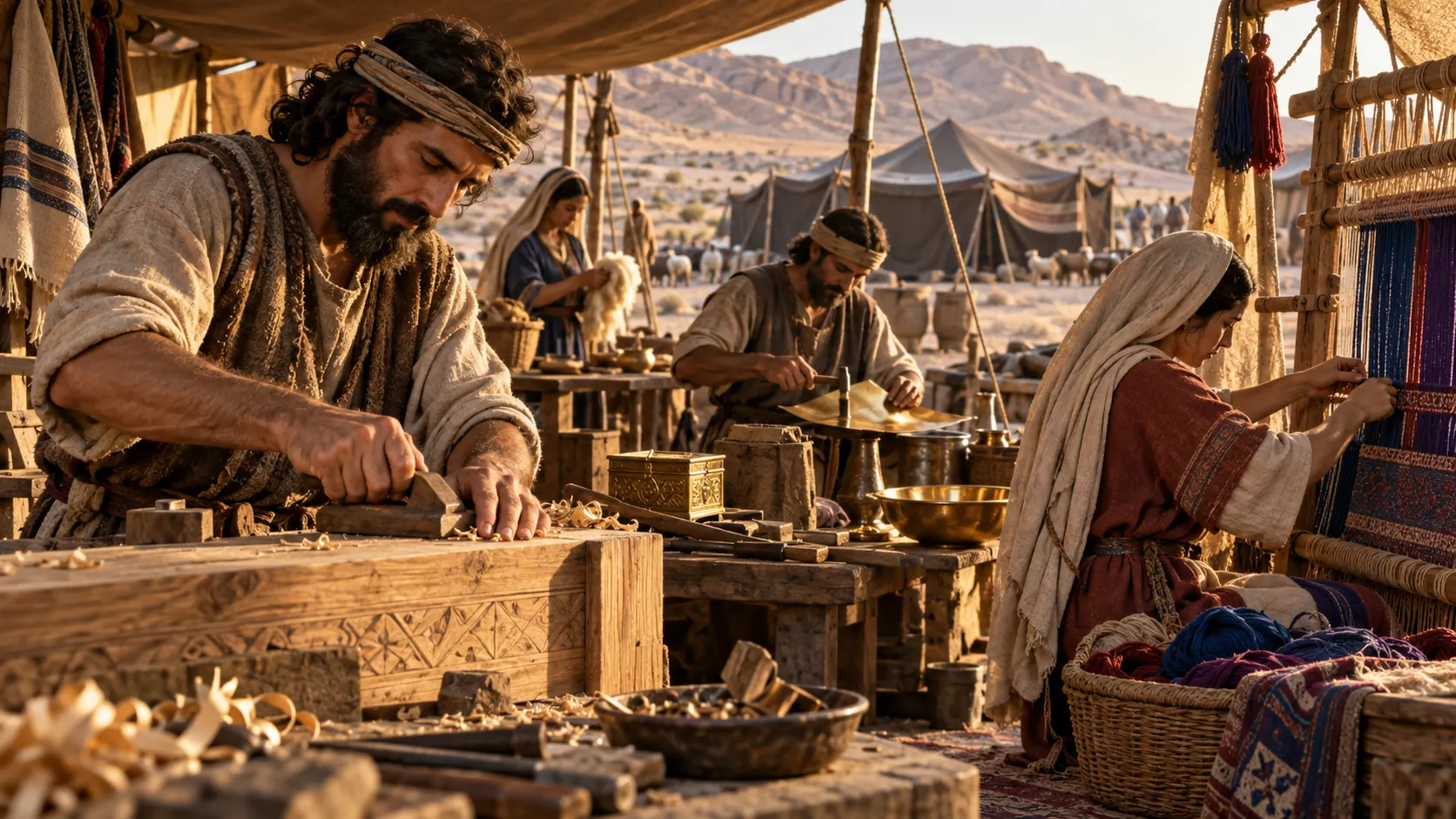
The discovery: the workbench belongs in the conversation
When we speak about spiritual service, our minds may go immediately to preaching, prayer, or public leadership. Exodus 31 requires us to widen our field of attention. God identifies a craftsman by name and equips him for work involving design, metals, stone, and wood. Knowledge and understanding have a visible, practical task to perform.
The passage concerns Bezalel, Oholiab, and the workers commissioned to make Israel’s tabernacle and its furnishings. It does not promise that every creative idea comes from God. It does establish that, within this commission, the Spirit’s provision includes skilled material work. We should allow that fact to enlarge our understanding of service without making the text say more than it does.
Our central question is therefore substantial: What happens when ability, understanding, and knowledge are placed under God’s instruction for the good of a worshiping community?
Begin with the setting: a particular people and a particular commission
Exodus 31 belongs to the instructions God gives Moses at Sinai. Earlier, Exodus 25:8–9 identifies the purpose of the sanctuary: God will dwell among the Israelites, and the sanctuary and its furnishings must follow the pattern he provides. The craftsmanship serves that covenant setting. This is more specific than a general celebration of human creativity.
The instructions extend across materials, dimensions, furnishings, priestly garments, and worship. By chapter 31, the reader has encountered a project requiring many kinds of competence. God’s provision includes people able to carry out what has been commanded. The work is spiritual in purpose and physical in execution; the narrative does not force us to choose between those realities.
A church building, classroom, or digital campus may offer a contemporary analogy for coordinated service. None is thereby the tabernacle of Exodus, and this passage does not authorize a ministry’s design preferences, spending, or leadership decisions simply because they are described as sacred. An analogy helps us think; it does not transfer the original commission to us.
Read closely: named people, concrete abilities, accountable work
In Exodus 31:1–2, the Lord speaks to Moses and identifies Bezalel, the son of Uri, the son of Hur, from Judah. The naming is explicit. The passage does not describe an anonymous atmosphere of creativity; it identifies a person and a task. We should resist adding an imagined biography or a private struggle that the text never supplies.
Verse 3 attributes Bezalel’s equipment to God’s Spirit. Verses 4–5 explain its practical expression: devising designs, working precious metals, cutting stones for settings, and carving wood. Design and execution both matter. Thinking through the work and handling its materials belong together in the commission.
Verse 6 names Oholiab, the son of Ahisamach, from Dan, alongside Bezalel. It also speaks of ability given to other skilled workers. The project is not reduced to one gifted individual. Verses 7–11 identify the objects they are to make, including the tent, the ark, other furnishings, priestly garments, anointing oil, and incense. The passage ends by binding their work to what God has commanded.
This is an important boundary for application: impressive ability is not permission to override instruction. The question is not merely whether the workers can produce something striking. Their work must serve the purpose for which they have been equipped.
Three Hebrew words: ability, understanding, and knowledge
Three terms in Exodus 31:3 deserve careful attention. Ḥokmah (חָכְמָה) has a range that includes wisdom and technical skill. Here the ESV renders it “ability.” The Brown–Driver–Briggs lexicon specifically includes craftsmanship within its discussion of this word. In this setting, wisdom has something to do with competent work, not merely with delivering a memorable saying.
Tevunah (תְּבוּנָה), rendered “intelligence” in the ESV here, concerns understanding. Daʿat (דַּעַת), rendered “knowledge,” concerns knowing; the same lexicon recognizes its use for skill in craftsmanship in this passage. The surrounding tasks help us understand how these words function. They describe equipment relevant to actual design and construction.
These terms overlap. The verse does not establish three rigid stages of spiritual advancement, nor does it give a formula in which knowledge automatically becomes understanding and then wisdom. Such a sequence might be someone’s teaching illustration, but it is not the grammatical argument of this sentence.
Likewise, a modern list of English synonyms cannot determine the meaning of the Hebrew. Intelligence, cleverness, expertise, and wisdom are not interchangeable in every context. Here we learn from the passage’s own setting: God supplies capacities through which the appointed work can be understood and accomplished.
The commission includes teaching others
Exodus 35:30–35 returns to the craftsmen’s appointment. Verse 34 adds an especially important detail: the capacity to teach is given to both Bezalel and Oholiab. The ability to perform and the ability to help others learn appear within the same account. The community needs more than finished objects; it also needs knowledge communicated through people.
For those preparing to teach, the contemporary application is clear without being identical to the ancient commission. Learn the work carefully. Understand what you are explaining. Give another person a way to examine, practice, and grow. Being admired for what you know is not the same accomplishment as helping someone else understand.
The wider chapter also names skilled women who spin materials for the work (35:25–26). Any retelling that celebrates the named men while erasing these contributors gives an incomplete picture. The text makes room for multiple workers, different materials, and distinct responsibilities within a shared purpose.
Skill does not settle the question of faithfulness
The next chapter after the commission records the making of the golden calf. Exodus 32:1–6 attributes its making to Aaron and describes the people’s disordered worship. It does not say that Bezalel made the calf. We must preserve that distinction even when comparing the two accounts.
Nevertheless, the proximity of the accounts gives us a sobering comparison: material resources and human making can be directed toward obedience or toward its corruption. Gold does not authenticate worship. Technical success does not establish theological truth. A beautiful object can still participate in a false representation of God.
For our own work, this is an application, not an accusation against every artist or institution: examine the message as seriously as the presentation. A polished quotation still needs an accurate source. An attractive teaching card still needs a sound interpretation. A persuasive speaker still needs to handle the passage honestly. Beauty deserves to serve truth.
Enough materials, honest reporting, and limits on work
Exodus 36:1–7 moves from appointment into execution. The workers have the skill and understanding needed for the sanctuary’s work, and the account also describes their willingness to participate. As contributions continue, the craftsmen report that more has been brought than the task requires. Moses then directs the people to stop bringing materials.
That episode does not promise that every ministry will always have excess resources. It does show workers reporting the actual need and leadership acting on that information. A responsible contemporary application is to describe needs truthfully, distinguish sufficient provision from endless expansion, and let the work’s purpose govern requests for support.
Exodus 31:12–17 also places Sabbath instruction immediately after the craftsmen’s commission. Its covenant sign and sanctions are addressed specifically to Israel. Christians differ over how Sabbath observance applies today; this paragraph does not settle that debate. Within the narrative, however, even this holy task does not grant permission to disregard God’s commands concerning rest. Sacred purpose does not make workers limitless.
Read the tabernacle within the larger biblical witness
A Christian reading must also attend to the New Testament’s treatment of the sanctuary. Hebrews 8:1–6 centers on Christ’s priestly ministry and speaks of the earthly sanctuary in relation to heavenly realities. Its direction is toward Christ and the better covenant, not toward declaring a modern ministry’s property the fulfillment of the tabernacle.
First Peter 4:10–11 offers a complementary instruction for Christian service: gifts are to be used for others, with service dependent upon God’s provision and directed toward his glory through Jesus Christ. We do not need to assign every contemporary worker Bezalel’s exact role in order to affirm that varied capacities can be put to faithful use.
These passages contribute different things. Exodus supplies the historical commission; Hebrews interprets the sanctuary within Christ’s priestly work; First Peter addresses the stewardship of gifts in Christian community. Reading across the Bible means honoring those differences while considering their relationships. It does not mean gathering unrelated verses until an appealing slogan appears convincing.
Bring the discovery into the work in your hands
The following are applications, rather than additional meanings hidden inside the Hebrew words. If you design, build, organize, write, teach, repair, or serve, ask what competent and truthful service requires in your particular responsibility. Spiritual language should deepen your care for the work’s quality and purpose.
For a learner, that may mean patiently acquiring a skill. For a teacher, it may mean checking the context before repeating a familiar explanation. For a designer, it may mean making a page readable for people with limited vision. For a leader, it may mean giving contributors credit, reporting needs accurately, and making room for others to learn.
The original commission does not guarantee our success or make every preference a revelation. It does challenge a narrow picture in which knowledge, reasoning, creative skill, and practical competence sit outside serious service to God. In this passage, they have work to do. Their purpose and accountability matter as much as their visibility.
Let Us Go Into The Throne Room Of Grace And Mercy.
Father, teach us to receive your Word with attention and humility. Help us to grow in understanding, to practice the skills entrusted to us, and to serve people with care. Keep us from mistaking impressive work for faithful work. Give us honesty about what we know, patience with what we must learn, and generosity toward those we can teach. Let our labor honor Jesus Christ and benefit those placed within our care. TO GOD BE THE GLORY!
Carry the discovery into your life.
Read Exodus 31:1–11 and 35:30–36:7 together. Name what the text explicitly says about equipment, collaboration, and instruction. Then identify one application for your own work and explain why it is an application. What skill needs development? Whose contribution needs recognition? What could you help someone else learn this week?