
The announcement often comes first
There was a time when forming an opinion required a little inconvenience. You had to read beyond the headline. You had to listen long enough to risk discovering that your first assumption was wrong. You had to sit with an idea before announcing what you thought about it.
Now the announcement often comes first.
We react while the facts are still arriving. We condemn while the context is still loading. We repost conclusions we did not investigate, defend arguments we did not construct, and mistake the speed of our response for the strength of our intelligence.
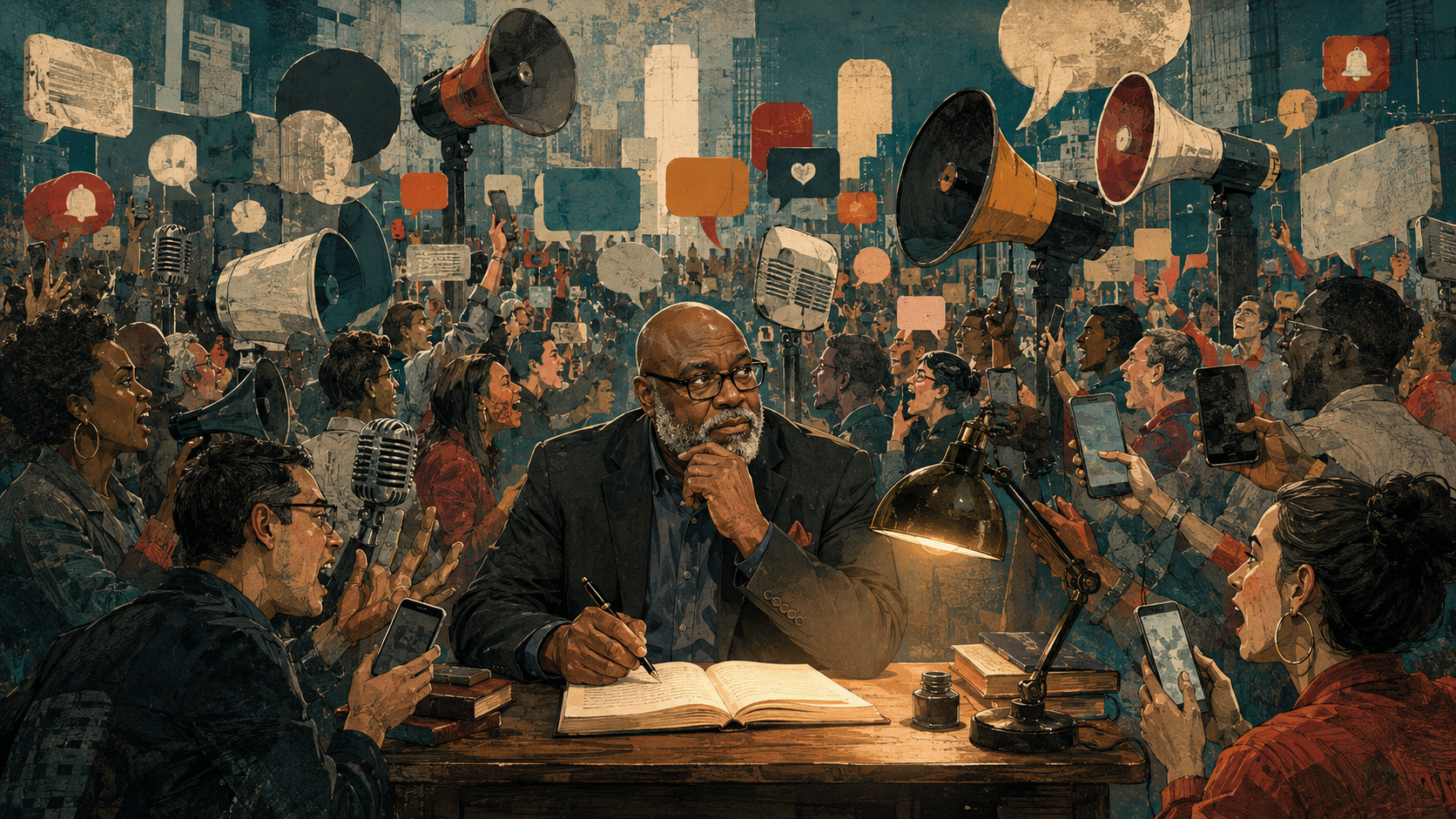
The modern world has not merely democratized speech. It has industrialized reaction.
Everyone has a platform. Every platform has an incentive. And nearly every incentive rewards immediacy over accuracy, certainty over curiosity, and emotional heat over intellectual light.
The result is a strange cultural contradiction: we have more access to information than any generation before us, yet we are increasingly impatient with the discipline required to understand it. We know how to search. We have forgotten how to seek.
A microphone can enlarge a voice, but it cannot deepen a mind.
Reaction now masquerades as intelligence
A reaction is immediate. A thought is developed.
A reaction asks, “How does this make me feel?” A thought continues, “What is actually true—and what evidence would require me to revise my position?”
There is nothing inherently wrong with an initial reaction. It is part of being human. The danger begins when we promote that reaction into a conclusion before it has survived examination.
Today, strong emotion is routinely presented as strong reasoning. Volume is confused with authority. Confidence is treated as evidence. If a statement is sharp enough, fast enough, or shareable enough, it can travel farther than a carefully qualified truth.
But virality is not verification.
An idea does not become wise because it trends. A claim does not become true because thousands of people repeat it in the same hour. The crowd can multiply a message without examining its meaning.
That is why our public conversations so often feel loud but thin. We are not always exchanging ideas; frequently, we are exchanging identities. People defend positions because those positions signal where they belong. Once a position becomes an identity, reconsidering it can feel less like intellectual honesty and more like tribal betrayal.
Once belonging becomes more important than truth, thinking becomes dangerous—because honest thought may lead you somewhere your group has forbidden you to go.
The economy of immediacy
The problem is not simply that people have become careless. We now live inside systems that profit from our lack of reflection.
Outrage keeps us looking. Anxiety keeps us refreshing. Certainty keeps us sharing. Nuance rarely arrives dressed for the algorithm.
The machinery of digital attention does not ask whether a thought is mature. It asks whether the content can move.
A mature idea often carries qualifications. It acknowledges tension. It leaves room for additional evidence. It can tell the difference between a person, a position, and a single poorly chosen sentence. But mature thought travels slowly because it asks something costly of the reader: patience.
The instantaneous opinion asks almost nothing. It offers a villain, a slogan, a side to join, and the intoxicating sensation of being morally certain before breakfast. We should not be surprised that it spreads.
The market discovered that human attention can be monetized. Then it discovered that agitation is one of the fastest ways to capture that attention. Consequently, many people now enter public conversations already emotionally recruited. They are not reading to understand. They are scanning for ammunition.
When every article becomes a battlefield, comprehension becomes a casualty.
We have confused access with understanding
The internet can place a library in your hand. It cannot make you read.
It can deliver a thousand perspectives. It cannot make you fairly represent even one with which you disagree.
It can retrieve data in seconds. It cannot supply judgment, humility, context, or intellectual character. Information is available. Wisdom must still be cultivated.
The Greek word phronēsis (φρόνησις) refers to practical wisdom—the disciplined capacity to judge what ought to be done in a particular situation. It is more than possessing facts. It is the moral and intellectual ability to use knowledge rightly.
The New Testament does not leave phronēsis in the philosopher’s classroom. Luke 1:17 sets it against disobedience: John the Baptist would turn “the disobedient to the wisdom of the just.” Ephesians 1:8 joins it to sophia—wisdom—as part of the grace God has lavished upon us “in all wisdom and insight.” Biblical phronēsis is therefore not cleverness detached from character. It is judgment redirected toward righteous living and illuminated by God’s redemptive purpose.
That biblical distinction exposes what public discourse increasingly lacks: not access to data, but disciplined moral judgment.
We celebrate the accumulation of information while neglecting the formation of the person handling it. Yet an undisciplined mind with unlimited access is not automatically enlightened. It may simply become more efficient at confirming its own bias.
The question is not merely, “What can you find?” The deeper question is, “What kind of thinker are you becoming while you search?”
Slow is not stupid
Our culture often treats hesitation as weakness. If you pause before answering, someone assumes you have no answer. If you revise your position, someone accuses you of inconsistency. If you admit uncertainty, someone more confident—but less informed—will gladly occupy the space you left open.
Yet intellectual maturity is not the absence of conviction. It is the refusal to counterfeit conviction where evidence is incomplete.
There is an ancient wisdom that feels almost subversive now: “Let every person be quick to hear, slow to speak, slow to anger” (James 1:19, ESV).
Notice the order. Hearing comes before speaking. The command does not worship silence; it disciplines speech.
To be slow to speak is not to be empty of thought. It may mean your words are undergoing inspection before they are released into the lives of other people. Silence can be cowardice, certainly. But silence can also be craftsmanship.
The carpenter measures before cutting because material matters. The surgeon studies before operating because bodies matter. The responsible thinker examines before declaring because truth matters—and because words, once released, can wound people who will never meet the person who posted them.
Thinking is moral labor
We often describe thinking as if it were merely academic, but serious thought is also ethical work.
It takes humility to admit that your preferred explanation may be incomplete. It takes courage to read someone you have been trained to dismiss. It takes integrity to correct a claim after people have applauded you for making it. It takes discipline to refuse the pleasure of publicly humiliating someone whose argument you could address without destroying their dignity.
These are not merely intellectual skills. They are matters of character.
A brilliant mind without intellectual honesty can become a sophisticated weapon. Knowledge does not automatically make a person truthful. Sometimes it merely gives deception a larger vocabulary.
That is why the formation of judgment matters as much as the acquisition of facts. We do not simply need people who can win arguments. We need people who can recognize truth even when truth embarrasses their side.
Before you publish the next opinion
The solution is not fewer voices. Too many voices have already been silenced by institutions, gatekeepers, prejudice, fear, and power. The expansion of public speech is not the enemy.
The challenge is to develop weightier voices.
Before publishing, reposting, or pronouncing judgment, the responsible thinker first interrogates the source of certainty: Do I know this, or have I merely encountered it? Exposure is not investigation, and a headline is an invitation—not a conclusion.
Then comes fairness. Can I state the opposing position so accurately that the person holding it would recognize the description? If not, I may be wrestling with a caricature built for easy defeat rather than an argument strong enough to deserve an answer.
Then comes surrender. What evidence would change my mind? If the honest answer is “nothing,” the position may have stopped functioning as a reasoned conviction and become an identity badge protected from examination.
Finally comes stewardship. Am I adding light—or merely adding myself? Not every conversation is improved by our arrival. And if the claim proves false, will I correct it as publicly as I shared it? Integrity should travel at the same volume as error.
These questions will not make us timid. They will make us trustworthy.
The rebellion of the thoughtful
In an age addicted to reaction, reflection is a form of resistance.
To read the entire argument is resistance. To delay judgment is resistance. To ask a sincere question when everyone else is reaching for a weapon is resistance. To say, “I was wrong,” is resistance. To refuse to let an algorithm decide whom you are permitted to understand is resistance.
For the Christian, this is not intellectual self-improvement with a Bible verse attached. The cross judges the ego that must win at another person’s expense, and the resurrection frees us to confess error without treating correction as death. Under the lordship of the crucified and risen Christ, listening becomes an act of love, restraint becomes spiritual discipline, and truth becomes service rather than self-display.
The future does not need another generation of people who can produce instant opinions on every subject placed before them. It needs people whose minds have enough depth to carry the weight of their own voices.
We do not earn the right to speak through moral perfection. Grace first humbles the speaker; then stewardship teaches us to carry the microphone without making ourselves the message.
We do not need to abandon the microphone.
We need to become worthy of it.
Study the evidence
Read the surrounding argument before drawing an application. Scripture links open in a new tab.
Practice interpreting before teaching
- Observe: identify the speaker, audience, situation, and two statements the passage makes explicitly.
- Interpret: state the conclusion in your own words and explain which details support it. Mark any inference.
- Compare: give a reasonable alternative reading fairly. Explain why the context supports or weakens it.
- Apply: propose one present-day response. Identify what the passage does not promise and whose circumstances require care.
- Revise: check the title, illustration, prayer, and assignment against the same evidence. Change any statement that exceeds it.
A strong response names evidence, handles an objection fairly, and distinguishes application from the passage’s direct statement. Agreement with a teacher alone is not a demonstration of understanding.
Published commitments, teacher exercises, and revision record →
“A microphone can enlarge a voice, but it cannot deepen a mind.”
— Bishop W. F. Houston Jr.Published by C H O F Ministry™ in The Sugar-Free Gospel Journal™.
Continue reading the Journal →