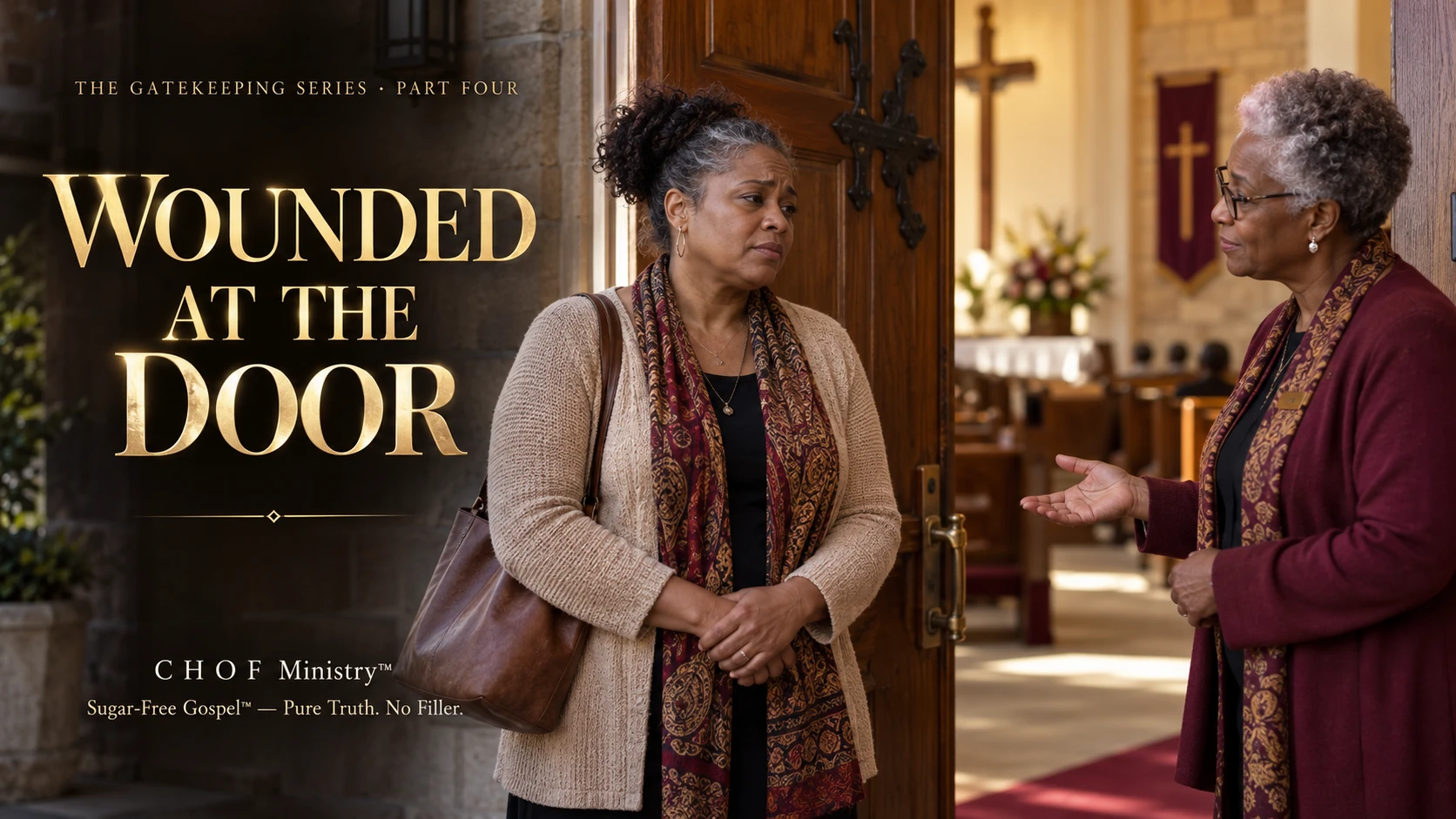
C H O F Ministry™ · The Gatekeeping Series
Wounded at the Door
Part 4 · Campus Reading Edition
Bishop W. F. Houston Jr.
Sugar-Free Gospel™ — Pure Truth. No Filler.
Igniting Faith, Elevating Wisdom, Transforming Lives.
Ezekiel 34:1–16 · ESV
Read the full passage in context before beginning the teaching.
Ezekiel 34 · ESVSome people approach a ministry carrying an injury they learned to conceal in another one. They can still explain the doctrine. They still remember the songs. What has become difficult is trusting the people who speak in God's name. Before we demand an explanation for their distance, we should examine what happened when they came close.
Ezekiel 34 gives teachers a necessary discipline: examine the shepherding before condemning the scattering. This is not a method for declaring every disappointed person innocent of every wrong. It is a demand that leaders answer for their own conduct without making someone else's conduct an excuse.
The chapter addresses Israel's shepherds within Ezekiel's exilic setting. It follows the report of Jerusalem's fall in chapter 33. Its horizon includes Israel's failed leadership, dispersed people, and promised restoration. Christian application must preserve that history. We cannot reduce the passage to a description of one unpleasant encounter at church.
In verses 2–6, leaders benefit from the flock while neglecting its needs. Vulnerability meets harshness. Scattering follows failed care. Verses 7–10 announce God's opposition to these shepherds and the termination of their exploitation. Verses 11–16 promise God's own searching, gathering, nourishment, and just care. The movement is from leadership's betrayal to God's intervention. Ezekiel 34 · ESV
The Hebrew verb רָעָה—rāʿâ means to tend, pasture, or shepherd. Its ordinary association with feeding helps illuminate the accusation: the people holding responsibility for provision have made themselves the beneficiaries of neglect. The word does not establish a modern leadership model by itself; the surrounding passage supplies the moral indictment. Hebrew word reference: rāʿâ
A title can identify a responsibility. It cannot prove that the responsibility is being fulfilled. When a ministry measures success only by what people contribute, it may overlook what happens to them while they contribute. The calendar stays full. The reputation grows. Meanwhile, those carrying the heaviest burdens learn that requesting help will be interpreted as insufficient commitment.
This is why spiritual harm demands more than polished reassurance. A statement that a ministry loves people must be tested against its treatment of people who cannot enhance its reputation. Consider the member who raises a concern, the volunteer who needs to stop, or the learner who admits confusion. What does our response reveal about the kind of care we actually provide?
Ezekiel's indictment also challenges the assumption that preserving a leader's position always preserves the flock. God can oppose the shepherds precisely because the sheep matter. Applied carefully, that principle means a ministry must be capable of removing responsibility from a person who has misused it. Continuity of office cannot outrank the well-being of those entrusted to that office.
Here we must resist a destructive shortcut: asking the injured person to make the situation comfortable before the truth has been faced. Reconciliation cannot be manufactured through a photograph, an embrace, or a public announcement. Forgiveness must never become a demand that someone restore access, abandon protective boundaries, or treat an unexamined apology as evidence of change.
Nor should a harmed person have to perform their pain publicly to make leadership take it seriously. Listening requires patience, careful attention to what is being reported, and a willingness to investigate without predetermined conclusions. Fair examination protects against careless accusations and institutional concealment. Neither the influence of the accused nor the status of the person reporting harm should settle the matter.
The promise of divine shepherding supplies a different picture of authority. God attends to people who have become scattered and vulnerable. This offers pastoral hope without promising that every wound will disappear quickly. A responsible teacher does not attach a spiritual deadline to another person's recovery or make immediate participation the proof that faith has returned.
For someone who has been wounded, a modest next step may be enough: reading a passage, asking an honest question, or speaking with a trustworthy person who respects boundaries. Participation can grow through freely chosen steps. A ministry worthy of trust allows people to observe its conduct rather than insisting that trust precede all evidence.
Faithful correction remains necessary. Its character matters. Correction identifies a real issue, explains the relevant truth, and seeks the person's good. Coercion recruits shame and fear to protect the authority figure. The difference becomes especially visible when the person asks for clarification. Can the leader explain the concern without claiming that examination itself dishonors God?
Teachers should ask concrete questions of their own practice. Who can challenge our account of an event? What happens when the concern involves someone important? Do our procedures protect a vulnerable person from retaliation? Have we acknowledged harm specifically, or hidden it beneath vague language about imperfect people? These questions require observable answers.
The final note of justice in verse 16 prevents us from turning care into mere pleasantness. In the following verses, God also confronts aggression within the flock. Restoration includes opposition to conduct that makes others unsafe. A welcoming ministry therefore needs both patience toward the wounded and firm resistance to exploitation. Mercy has enough substance to protect.
We teach teachers. That assignment requires us to prepare people to recognize faithful care, including the care we ourselves owe. Every lesson about leadership should eventually reach the person who has little influence and much to lose. What would our teaching permit us to do to that person? What would it require us to do for them?
If you were wounded at a ministry's door, the failure of those who received you does not establish that God has discarded you. And if you hold that door for others, do not ask your reputation to answer questions that only your conduct can answer. Let care become visible, accountability become credible, and truth become safe to speak.
Let Us Go Into The Throne Room Of Grace And Mercy.
Father, attend to those who have been wounded where they expected care. Give them room to speak truth without pressure to conceal their pain. Surround them with trustworthy people who respect their dignity and boundaries.
Examine us who teach and lead. Expose neglect, coercion, and the desire to protect ourselves at another person's expense. Give us courage to investigate honestly, acknowledge wrong specifically, and change our conduct. Teach us to exercise authority with justice, patience, and faithful care.
TO GOD BE THE GLORY!Benediction
Beloved, may you encounter care that honors truth, boundaries that protect dignity, and teaching that strengthens discernment. May those entrusted to your influence find patience, integrity, and a faithful witness to the Shepherd's concern.