
FOUNDATIONAL READING · ESV
Luke 22:42
Read the complete passage slowly before entering the reflection. Let the biblical text govern every application that follows.BIBLICAL WORD INSIGHT · GREEK
THE WORD
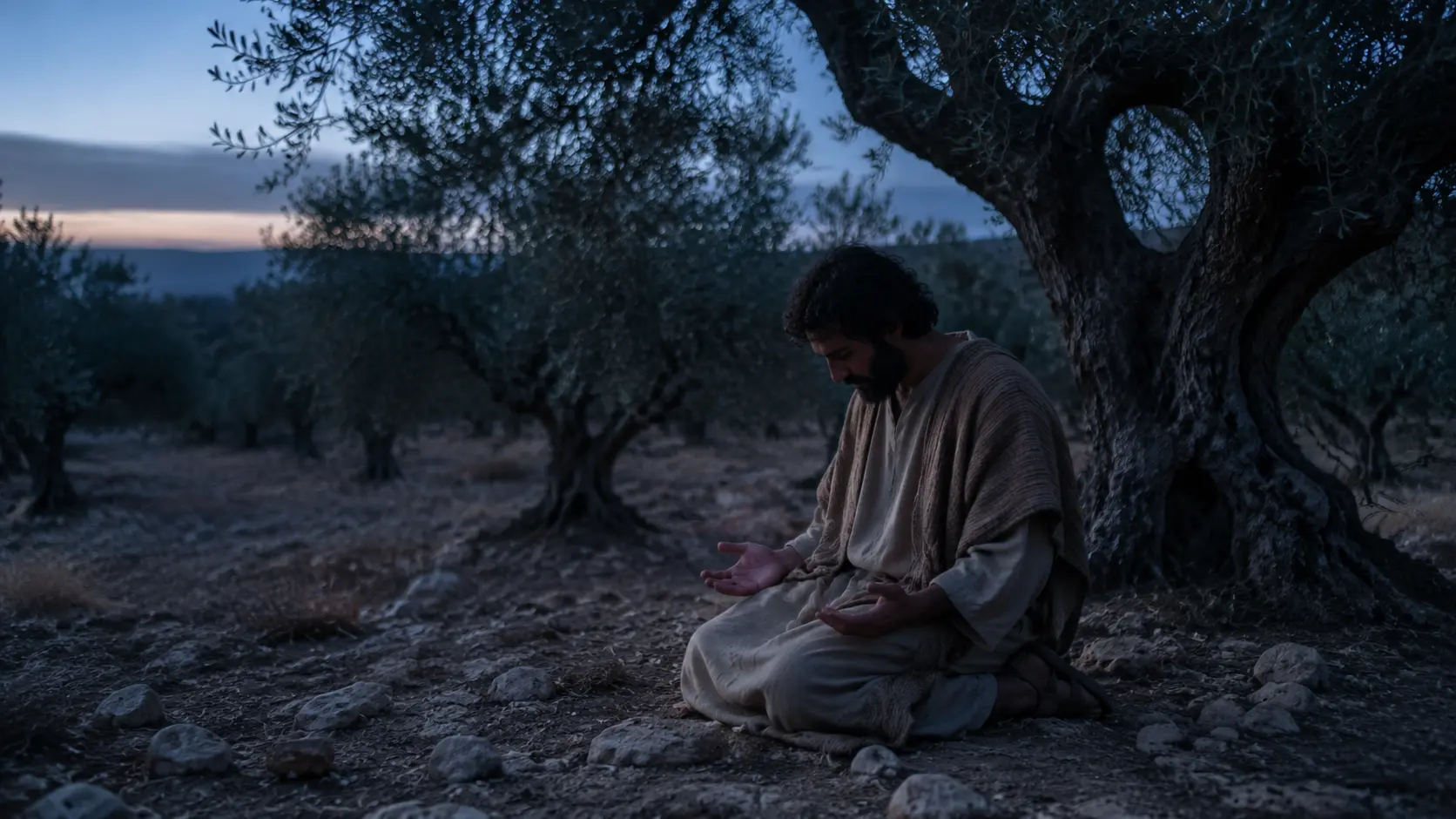
Gethsemane is the most sacred and the most confronting location in the Gospels — not Golgotha, not the Upper Room, not the Mount of Transfiguration. Gethsemane. Because Gethsemane is where the will of God and the will of Jesus — fully human, feeling the full weight of what lay ahead — came into the most agonizing imaginable tension, and where the decisive, eternal, history-altering choice was made. Jesus was not in a comfortable sanctuary with soft ambient music when He prayed "not my will but yours." He was on the ground. He was sweating drops of blood — a physiological response to extreme psychological and physical distress called hematidrosis. The disciples were asleep. He was alone. And what God was asking was going to cost Him everything. And He said it anyway. Not as a worship lyric. Not as a spiritual aspiration.
As a real, costly, fully-meant surrender to the will of the Father at the precise moment when what the Father was asking was the most extreme possible demand on His humanity. The prayer "not my will but yours" is the most powerful prayer in Scripture — and the most frequently prayed insincerely. It is sung in worship services as a beautiful spiritual sentiment. It is prayed at the end of requests as a pious qualifier — "Lord, I want this job, but not my will but yours" — meaning: "I want the job, and I am hoping 'not my will' is the spiritually correct way to guarantee that You agree with me." That is not surrender. That is manipulation dressed in the language of submission. Real surrender sounds like Jesus in Gethsemane: "Father, if it is possible, let this cup pass from me." Honest about the preference. Honest about the cost. Honest about the weight of what is being asked. And then — not my will, but Yours. Meaning it. Fully. With the cup still on the table. With the cross still coming.
Surrender to God must never be confused with surrender to an abuser, manipulative leader, or unsafe institution. God’s will is consistent with His holy character. Seeking safety, reporting wrongdoing, receiving treatment, and setting boundaries can be acts of obedience rather than resistance.
CONFRONTATION QUESTION
Where does Luke 22:42 confront your present practice, and what truthful, responsible step would embody its call without shaming, coercing, or harming another person?
FAITH RESPONSE
🙏🏿 LET US GO INTO THE THRONE ROOM OF GRACE AND MERCY.™
Prayer
Truth must become practice.
Read Luke 22:42 in its full chapter. Write one sentence naming what the passage actually says, one misuse you must reject, and one concrete action that expresses faithful obedience with truth, safety, and love.
Study the evidence
Read the surrounding argument before drawing an application. Scripture links open in a new tab.
Practice interpreting before teaching
- Observe: identify the speaker, audience, situation, and two statements the passage makes explicitly.
- Interpret: state the conclusion in your own words and explain which details support it. Mark any inference.
- Compare: give a reasonable alternative reading fairly. Explain why the context supports or weakens it.
- Apply: propose one present-day response. Identify what the passage does not promise and whose circumstances require care.
- Revise: check the title, illustration, prayer, and assignment against the same evidence. Change any statement that exceeds it.
A strong response names evidence, handles an objection fairly, and distinguishes application from the passage’s direct statement. Agreement with a teacher alone is not a demonstration of understanding.
Published commitments, teacher exercises, and revision record →