
C H O F Ministry — Unified Manna™: Where Scripture Meets Innovation
Do Not Call the Pruning Rejection
The hand removing what limits fruit is the same hand committed to your growth.

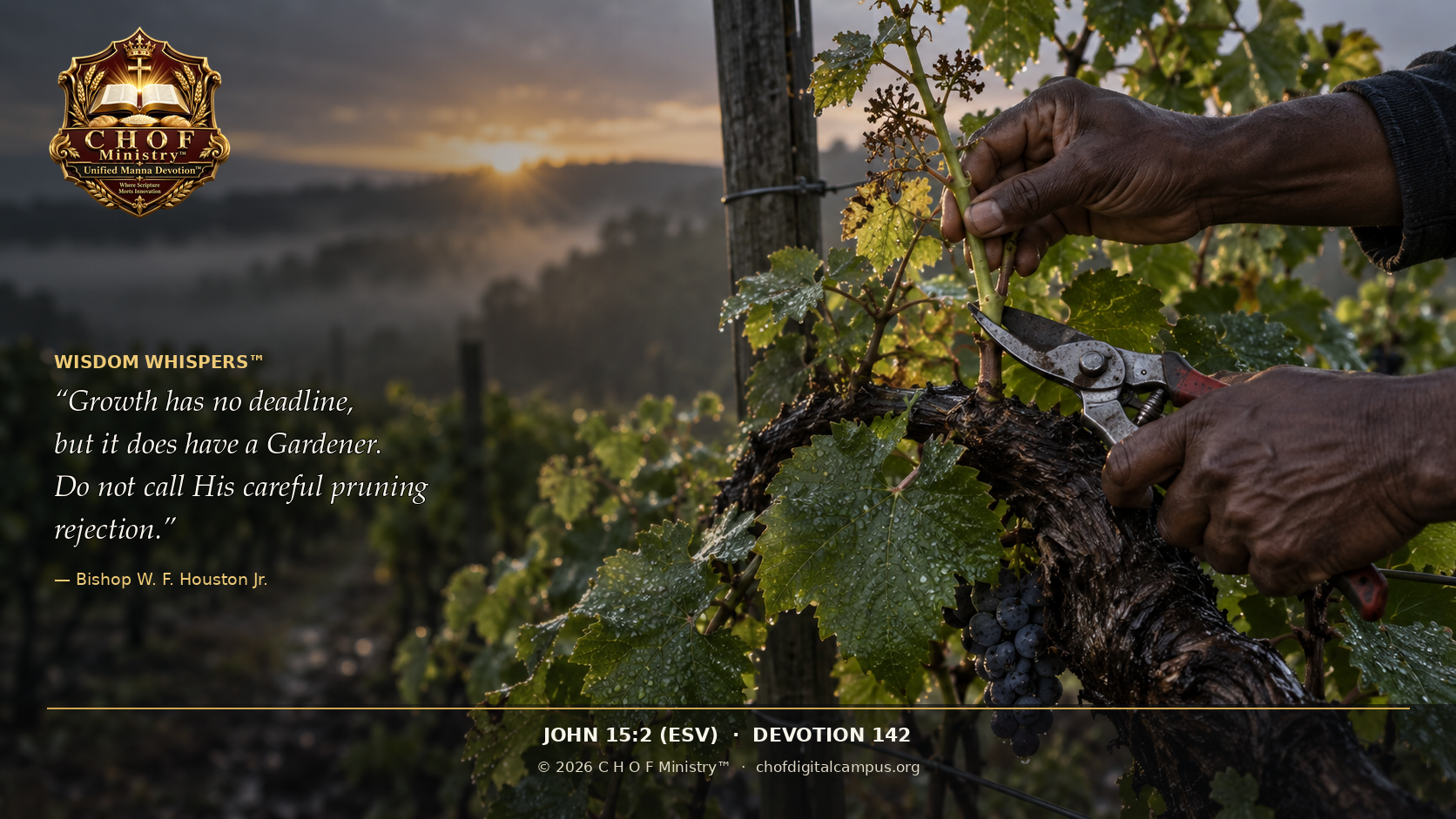
FOUNDATIONAL SCRIPTURE · ESV
“Every branch in me that does not bear fruit he takes away, and every branch that does bear fruit he prunes, that it may bear more fruit.”John 15:2 (ESV)
WISDOM WHISPERS™
“Growth has no deadline, but it does have a Gardener. Do not call His careful pruning rejection.”— Bishop W. F. Houston Jr.
Word StudyFrom kathairō: he cleanses or prunes. Jesus uses a word that joins cutting with cleansing. The Father’s purpose is not random reduction but the careful removal of what obstructs greater fruitfulness.
THE DEVOTION
Monday established that growth has no deadline. Thursday brings the necessary correction: growth is not merely the result of passing time. It is cultivated beneath the Father’s hand. A branch can be alive, attached, and already bearing fruit—and still require cutting.
Jesus identifies Himself as the true vine and His Father as the vinedresser. Then He gives us a truth comfortable religion avoids: ‘Every branch that does bear fruit he prunes, that it may bear more fruit.’ We assume correction belongs only to what is barren. Christ says fruitfulness does not exempt a disciple from pruning; it places that disciple within the Gardener’s careful preparation for greater fruit.
The Greek word kathairei comes from kathairō, meaning he cleanses or prunes. Jesus joins cutting with cleansing. A skilled vinedresser does not slash the vine in anger. He removes crowded, diseased, and misdirected growth so the life already flowing through the branch can reach its proper purpose. The cut is not proof that the branch has been rejected. It may be evidence that the branch is being responsibly tended.
This confronts our habit of calling every painful subtraction abandonment. We cling to habits, commitments, applause, and relationships simply because they once produced something. We ask God for growth while defending the very excess that consumes our strength. Yet not every loss should be labeled divine pruning. Human sin, injustice, irresponsibility, and ordinary grief also wound people. Test the interpretation by Scripture, wise counsel, the character of Christ, and the fruit being produced.
Growth has no deadline, but it does have direction. Slow growth can be faithful; protected dysfunction cannot. The Father may prune an overcrowded schedule, an undisciplined appetite, a platform built upon approval, or a pattern that keeps leaves visible while fruit remains scarce. Grace gives you time to mature, but grace will not help you preserve what Christ has exposed as unfruitful.
Stop negotiating with the shoot the Spirit has identified. Submit it to the Gardener. The pruning may feel like reduction, but holy reduction is not destruction. The Father is not committed to keeping you comfortable, impressive, or busy. He is committed to making you fruitful. Do not call His careful pruning rejection.
PERSONAL EXAMINATION
FAITHFUL RESPONSE
Study the evidence
Read the surrounding argument before drawing an application. Scripture links open in a new tab.
Practice interpreting before teaching
- Observe: identify the speaker, audience, situation, and two statements the passage makes explicitly.
- Interpret: state the conclusion in your own words and explain which details support it. Mark any inference.
- Compare: give a reasonable alternative reading fairly. Explain why the context supports or weakens it.
- Apply: propose one present-day response. Identify what the passage does not promise and whose circumstances require care.
- Revise: check the title, illustration, prayer, and assignment against the same evidence. Change any statement that exceeds it.
A strong response names evidence, handles an objection fairly, and distinguishes application from the passage’s direct statement. Agreement with a teacher alone is not a demonstration of understanding.
Published commitments, teacher exercises, and revision record →
Let Us Go Into The Throne Room Of Grace And Mercy.
Prayer
BENEDICTION