
C H O F Ministry — Unified Manna™: Where Scripture Meets Innovation
Life Will Not Ask Your Permission
Life may present the conditions, but life does not become sovereign—God remains Lord.

FOUNDATIONAL SCRIPTURE · ESV
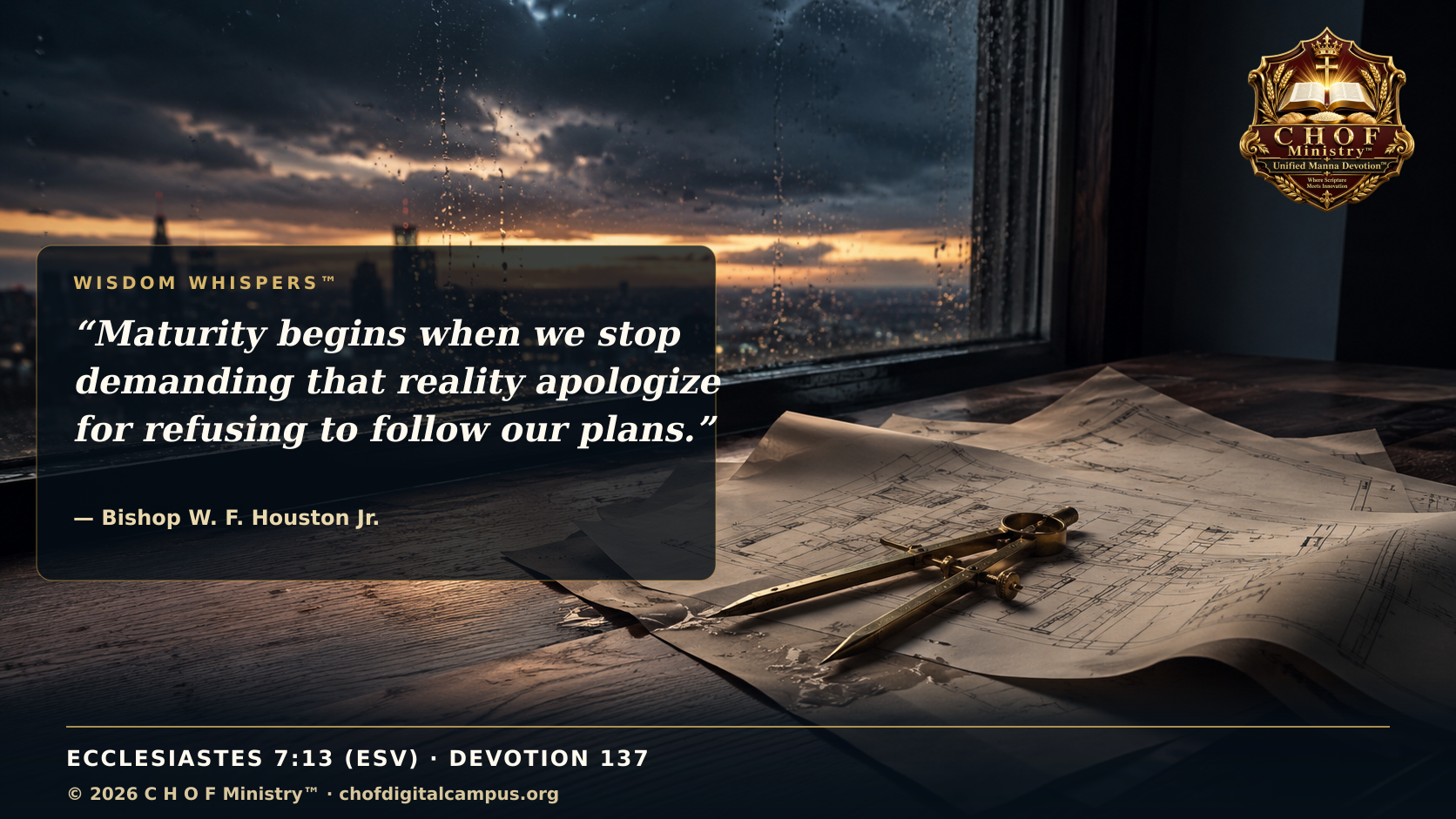
“Consider the work of God: who can make straight what he has made crooked?”Ecclesiastes 7:13 (ESV)
WISDOM WHISPERS™
“Maturity begins when we stop demanding that reality apologize for refusing to follow our plans.”— Bishop W. F. Houston Jr.
Word StudySee, perceive, or consider carefully. Solomon does not command a passing glance at life. He calls us to look long enough to recognize God’s activity within realities human will cannot simply rearrange.
THE DEVOTION
We are not exhausted only by what happened. We are often exhausted by our private argument that it should not have happened. The diagnosis was unexpected. The relationship changed. The opportunity closed. The body aged. The plan failed. Life entered without requesting our approval, and we kept trying to negotiate with a reality that was already in the room.
Ecclesiastes does not tell us to admire the problem or surrender to despair. It commands us to consider the work of God. The Hebrew imperative reʾeh means see, perceive, or consider carefully. Look again—not merely at what has become difficult, but at the God whose providence remains active when human will cannot straighten every condition. Life may present the terms, but life does not become sovereign. God remains Lord.
The crooked thing in this verse is not moral evil that must be tolerated. Scripture never turns acceptance into permission for abuse, injustice, neglect, or avoidable harm. Some doors should be challenged. Some wounds require treatment. Some relationships need boundaries. Yet other losses cannot be reversed, and certain limitations cannot presently be removed. Wisdom discerns the difference between a condition faith must confront and a condition faith must inhabit.
Our error is believing that faithfulness can begin only after reality becomes agreeable. We postpone obedience until the body feels stronger, the money arrives, the apology comes, or the plan returns to its original shape. But we cannot serve God inside an imaginary life. Obedience can occur only here—within this season, this responsibility, this limitation, and this unfinished story.
Acceptance is not approval, passivity, or defeat. It is truth-telling before God: ‘This is what is presently true, and You are still God here.’ Stop demanding that reality apologize. Ask the sharper question: Given what is now true, what does faithfulness require of me? That question does not surrender your future. It returns your present to God—and places your next step back beneath His authority.
PERSONAL EXAMINATION
FAITHFUL RESPONSE
Study the evidence
Read the surrounding argument before drawing an application. Scripture links open in a new tab.
Practice interpreting before teaching
- Observe: identify the speaker, audience, situation, and two statements the passage makes explicitly.
- Interpret: state the conclusion in your own words and explain which details support it. Mark any inference.
- Compare: give a reasonable alternative reading fairly. Explain why the context supports or weakens it.
- Apply: propose one present-day response. Identify what the passage does not promise and whose circumstances require care.
- Revise: check the title, illustration, prayer, and assignment against the same evidence. Change any statement that exceeds it.
A strong response names evidence, handles an objection fairly, and distinguishes application from the passage’s direct statement. Agreement with a teacher alone is not a demonstration of understanding.
Published commitments, teacher exercises, and revision record →
Let Us Go Into The Throne Room Of Grace And Mercy.
Prayer
BENEDICTION