
C H O F Ministry™ — Unified Manna Devotion™: “Where Scripture Meets Innovation”
Living Faith Leaves Evidence
Now it’s Thursday. What happened after you said you would?

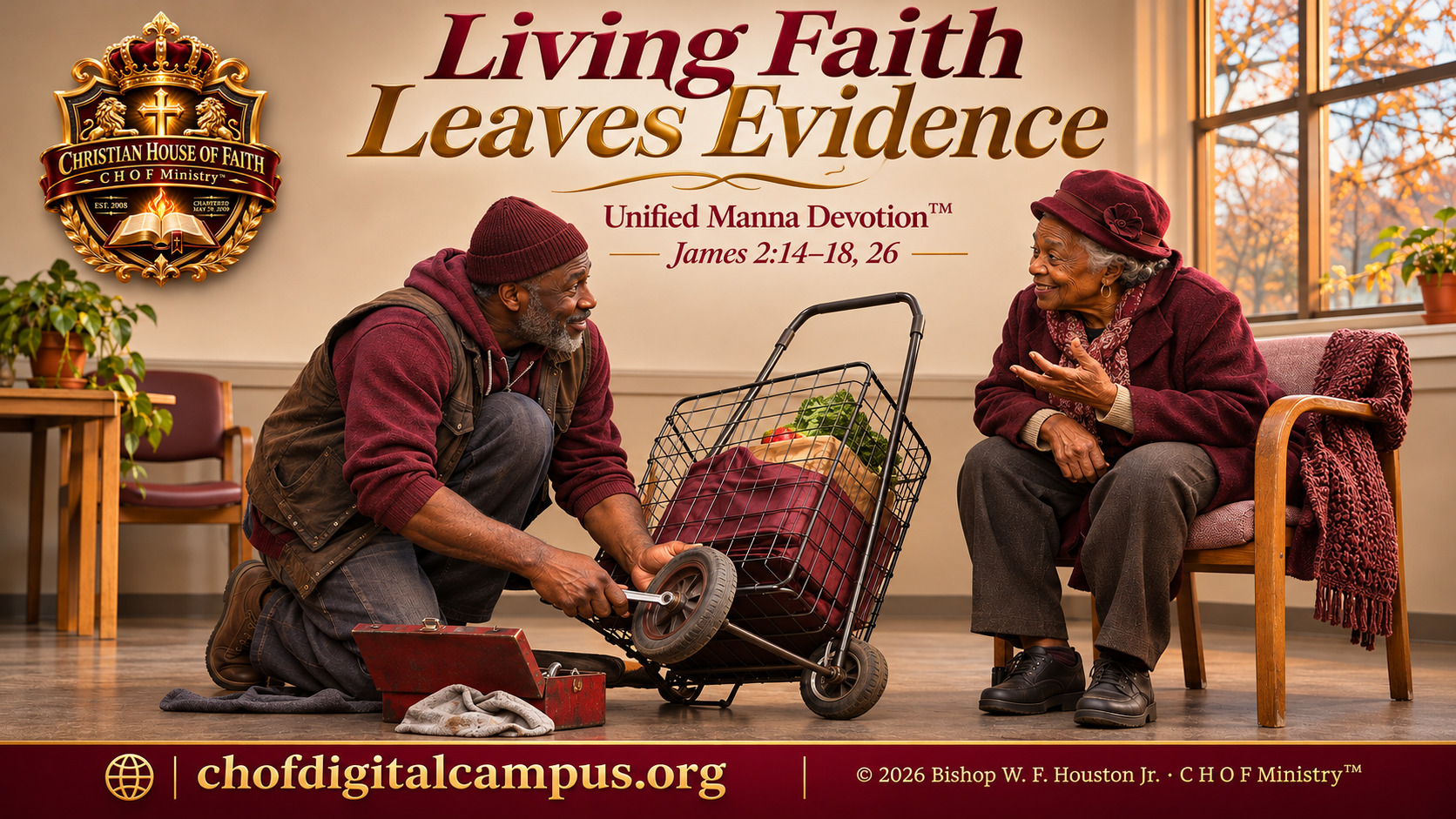
FOUNDATIONAL SCRIPTURE · ESV
“I will show you my faith by my works.”James 2:18 (ESV)
WISDOM WHISPERS™
“An intention can comfort your conscience while leaving your neighbor exactly where you found them.”— Bishop W. F. Houston Jr.
THE DEVOTION
Monday, we accepted an assignment: recognize a need, listen, and complete one responsible act of care.
Now it’s Thursday. What happened after you said you would?
That question doesn’t need an impressive answer. It needs an honest one.
In James 2:15–16, a brother or sister lacks clothing and daily food. Someone offers peaceful words but withholds practical help. James asks what good that does. The problem isn’t that the blessing sounds wrong. It’s that the person remains hungry.
That’s the setting for his declaration that faith without works is dead. James repeats that verdict in verse 26. “Living faith” means more than sincere feelings; it describes trust in God that acts.
The Greek ἔργα (erga) means “works” or “deeds.” Its theological significance comes into focus beside Romans 3:28, where Paul teaches justification by faith apart from works of the law. Paul rejects works as the basis of our acceptance before God; James rejects a claim to faith that produces no corresponding obedience. We don’t serve to purchase grace. We serve because grace has taken hold of us. James is plain: professed faith must have more to show than words.
Perhaps you kept your commitment. Good. Now examine how you helped. Did you listen or take over? Can you let kindness stand without collecting recognition?
A person you’ve helped doesn’t owe you an audience, allegiance, or access to their private life.
Perhaps you started but didn’t finish. A call went unanswered. Your schedule changed. An obstacle isn’t automatically disobedience. But silence can leave someone depending on a promise you’ve quietly abandoned. Explain what changed. Make a commitment you can keep.
Perhaps you did nothing.
Don’t rename avoidance “waiting on God” when you already understood the responsibility. Repentance can begin with an uncomfortable sentence: “I said I would, and I didn’t.” Then take the next faithful step.
Perhaps illness, exhaustion, or limited resources restricted what you could do. Don’t measure faithfulness by somebody else’s capacity. And if you’re the one in need this week, receiving help isn’t spiritual failure. James calls the community to care for you, too.
Today, take the next responsible step on Monday’s commitment.
You cannot control whether someone thanks you, accepts your help, or changes their life. You can take responsibility for whether your word remains trustworthy.
Living faith leaves evidence—even when nobody applauds.
Study the evidence
Read the surrounding argument before drawing an application. Scripture links open in a new tab.
Practice interpreting before teaching
- Observe: identify the speaker, audience, situation, and two statements the passage makes explicitly.
- Interpret: state the conclusion in your own words and explain which details support it. Mark any inference.
- Compare: give a reasonable alternative reading fairly. Explain why the context supports or weakens it.
- Apply: propose one present-day response. Identify what the passage does not promise and whose circumstances require care.
- Revise: check the title, illustration, prayer, and assignment against the same evidence. Change any statement that exceeds it.
A strong response names evidence, handles an objection fairly, and distinguishes application from the passage’s direct statement. Agreement with a teacher alone is not a demonstration of understanding.
Published commitments, teacher exercises, and revision record →
🙏🏿 Let Us Go Into The Throne Room Of Grace And Mercy™.
Prayer
BENEDICTION