
C H O F Ministry — Unified Manna™: Where Scripture Meets Innovation
The Politics We Call “Ministry”
When protecting our position becomes more important than serving people, our motives need examination.

FOUNDATIONAL SCRIPTURE · ESV
“I have written something to the church, but Diotrephes, who likes to put himself first, does not acknowledge our authority. So if I come, I will bring up what he is doing, talking wicked nonsense against us. And not content with that, he refuses to welcome the brothers, and also stops those who want to and puts them out of the church.”3 John 9–10 (ESV)
“But it shall not be so among you. But whoever would be great among you must be your servant.”Mark 10:43 (ESV)
WISDOM WHISPERS™
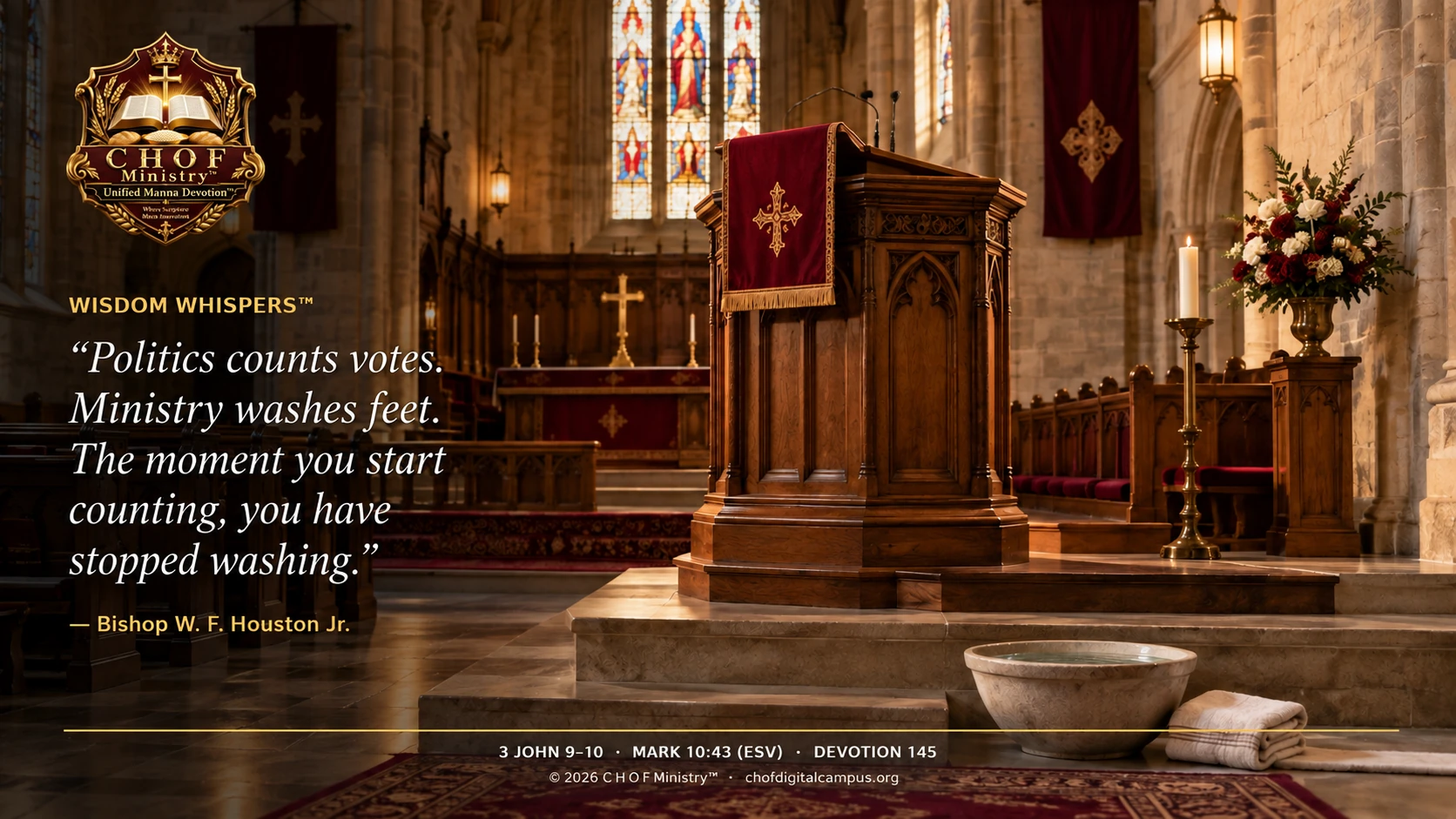
“Politics counts votes. Ministry washes feet. The moment you start counting, you have stopped washing.”— Bishop W. F. Houston Jr.
THE DEVOTION
The Controlling Tension
There is a man in the New Testament whom John rebukes without bringing a charge of heresy, denial of the resurrection, or sexual sin. His name is Diotrephes. John gives us a devastating account of his conduct: he loved first place, rejected John’s authority, spread malicious accusations, refused to welcome the brothers, and drove out people who wanted to receive them. His appetite for prominence had consequences for everyone around him. And here is the part that should make every reader sit up: this was happening inside the church.
That is the tension. Politics does not announce itself. It borrows the vocabulary of ministry. It says "order" when it means control. It says "covering" when it means ownership. It says "loyalty" when it means silence. It says "protecting the vision" when it means protecting the man. And because it uses the right words, the people who practice it often cannot tell the difference between their calling and their campaign.
Exposition and Revelation
John’s stated charges concern Diotrephes’ conduct: he puts himself first, rejects apostolic authority, spreads malicious talk, refuses hospitality, and expels people who extend it. These are the actions the text records. When we call this “ministry politics,” we are applying a contemporary description to that pattern of self-serving control. We are talking about the use of relationships, access, and influence to protect personal prominence. Ordinary administration, voting, and responsible accountability are not the target.
Notice what John does with it. He does not say, "Well, he has a strong personality, but the church is growing." He does not say, "He's difficult, but God is using him." He names the malicious speech and states his intention to address Diotrephes’ actions if he comes. John treats this conduct as wrongdoing that demands accountability.
Then set Diotrephes beside the words of Jesus in Mark 10. James and John requested seats of honor, and the other ten became indignant. Mark leaves their motives unstated, but Jesus gathers all of them to correct their understanding of greatness. He describes those regarded as Gentile rulers exercising domineering authority. Then He draws a hard line: “It shall not be so among you.”
That line is the whole devotion. Jesus is not describing the church's culture. He is legislating it. The worldly model of leadership, where greatness is measured by who submits to you, is not merely discouraged in the kingdom. It is forbidden. And the alternative He gives is not a softer version of dominance. It is its inversion: the servant, the slave, the one who gives his life.
Mark 10:45 takes us deeper: Jesus gives His life as a ransom for many. His service reaches its saving fulfillment in His death. Our humility cannot redeem anyone or purchase God’s favor. We serve in grateful response to the Savior who gave Himself for us. This keeps the call to service rooted in the gospel.
Diotrephes’ example warns us how religious influence can be used to secure personal importance. Christ’s example and command expose that ambition. A platform entrusted to us becomes dangerous when we treat the people before it as possessions. The question reaches beyond our gifts to the desires governing their use.
Biblical Language Study
John describes Diotrephes as φιλοπρωτεύων (philoprōteuōn), “loving to be first.” It is a participial form of φιλοπρωτεύω (philoprōteuō), a verb occurring once in the New Testament. The word exposes the desire governing his behavior: Diotrephes loves prominence. The problem reaches beneath his position to what he loves. (Greek reference)
Set beside it the word Jesus uses in Mark 10:43: διάκονος (diakonos), “servant.” The English “deacon” derives from this Greek word. Its related noun, διακονία (diakonia), is often translated “ministry” or “service.” The English word “ministry” itself comes through Latin ministerium, meaning service or duty. In Jesus’ teaching, greatness carries an obligation to serve others. (Deacon; diakonia; ministry)
Diotrephes loves prominence. Jesus requires service. That contrast presses a question upon us: whose good governs our decisions? Repeated choices to protect our importance can train us to value prominence more than people. Examine those choices before they become your settled way of life.
Scripture gives God’s people a heavenly citizenship (Philippians 3:20). That identity places our allegiance under the Lord Jesus Christ. We have no authority to make ourselves the final object of another believer’s loyalty. The throne is already occupied. Ministry gives us work to do under Christ’s authority; it gives us no campaign to replace Him. (Philippians 3:20)
Application and Confrontation
Some of you are pastors or ministry leaders. Others guide a family, quote Scripture to friends, or offer someone biblical direction. Some are learning to do those things faithfully. We teach teachers: we equip people to become faithful carriers and communicators of God’s Word. Every person we influence deserves truth handled with care. You do not need a pulpit to turn a biblical quotation into a means of control.
To the leader: examine your reactions, not your sermons. A polished sermon can conceal what a defensive reaction exposes. When someone in your congregation gains influence you did not grant, what rises in you? When a gifted person under your care is invited to serve elsewhere, do you bless it or block it? When you are corrected, do you weigh the correction or investigate the corrector? When you lose control of a room, do you grieve for the people or for yourself? Those answers help expose the motives governing your influence.
To the leader who hides behind "protecting the vision": the vision belongs to Christ. If it is genuinely His, it does not require you to manipulate people to keep it alive. Diotrephes’ example gives us reason to examine our explanations: have we called a decision necessary for the church when it was necessary mainly for our status?
To the member: Diotrephes refused hospitality and drove out those willing to extend it. His conduct deserves examination, whatever his standing. If you recognize such behavior, seek truthful, responsible accountability. Fear, dependence, or uncertainty may make speaking difficult; silence alone does not prove that a wounded person approves of what is happening. Seek trustworthy support rather than carrying that burden alone.
But hear me: opposition to manipulation does not excuse manipulation of your own. John states his intention to address the actions if he comes. He then directs his reader to imitate good rather than evil and commends Demetrius’ testimony (3 John 11–12). Follow that direction: address the conduct, tell the truth, and imitate what is good. Retaliatory gossip and factions built around personal revenge reproduce the very wrongdoing you claim to oppose. You can challenge wrongdoing while refusing to reproduce it.
And to everyone: examine the ambition that can attach itself to meaningful service. Take the tasks nobody sees. Give credit that costs you visibility. Welcome the person whose gift threatens your prominence. Refuse to trade support for favors. When you offer biblical direction, let the passage govern your counsel even when it challenges your preference. Serve wherever Christ places you without making recognition a condition of your obedience.
Jesus said it shall not be so among you. That is not a suggestion. It is the constitution of the kingdom. The question is whether your ministry is governed by it, or merely decorated with it.
Study the evidence
Read the surrounding argument before drawing an application. Scripture links open in a new tab.
Practice interpreting before teaching
- Observe: identify the speaker, audience, situation, and two statements the passage makes explicitly.
- Interpret: state the conclusion in your own words and explain which details support it. Mark any inference.
- Compare: give a reasonable alternative reading fairly. Explain why the context supports or weakens it.
- Apply: propose one present-day response. Identify what the passage does not promise and whose circumstances require care.
- Revise: check the title, illustration, prayer, and assignment against the same evidence. Change any statement that exceeds it.
A strong response names evidence, handles an objection fairly, and distinguishes application from the passage’s direct statement. Agreement with a teacher alone is not a demonstration of understanding.
Published commitments, teacher exercises, and revision record →
Let Us Go Into The Throne Room Of Grace And Mercy.
Prayer
BENEDICTION