
FROM THE BISHOP’S DESK™ · SEPTEMBER 2026
AI Is Not the Enemy—
Undisciplined Humanity Is
A Christian View of Artificial Intelligence and the Church
“All things are lawful,” but not all things are helpful. “All things are lawful,” but not all things build up.1 Corinthians 10:23 · ESV
Wisdom expressed as disciplined skill—the ability to bring knowledge into faithful practice without violating the purpose of God.
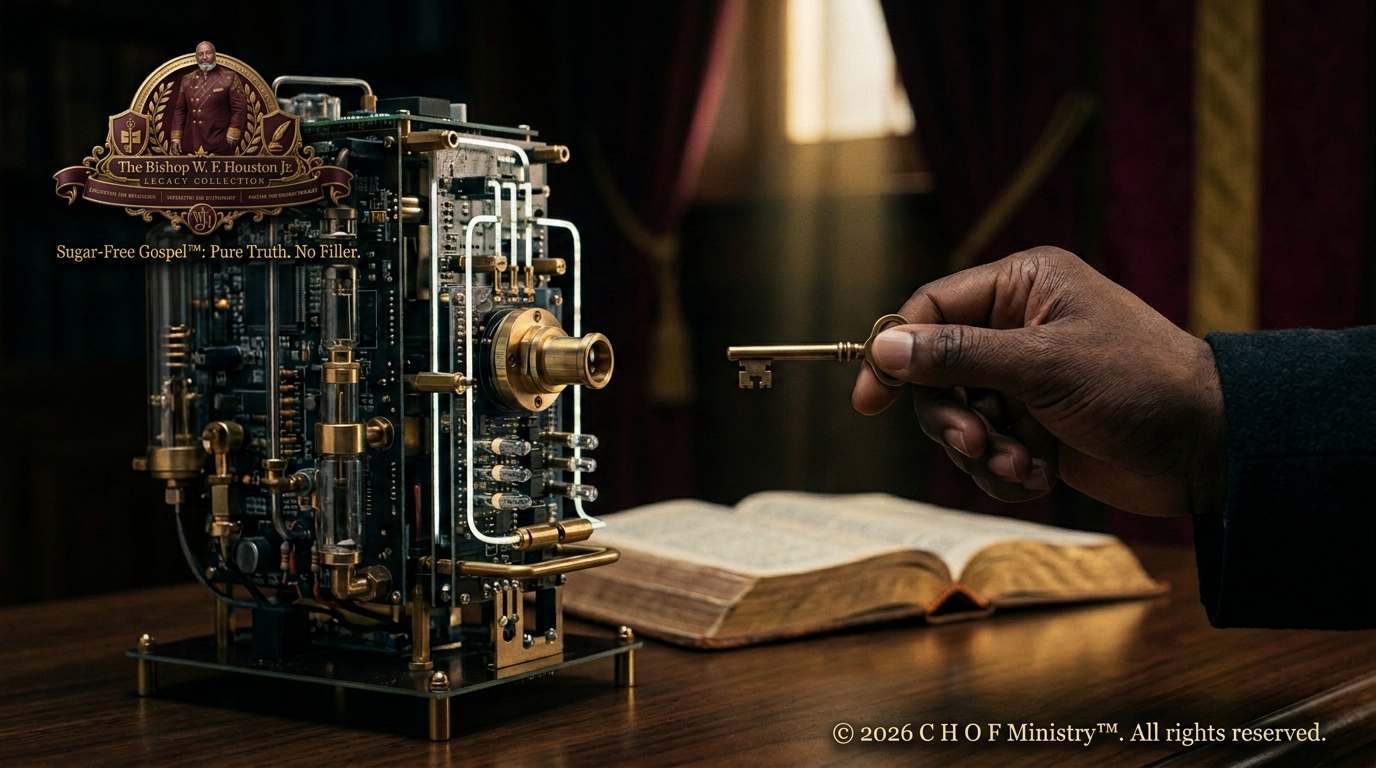

“A machine may accelerate the work, but it must never inherit the conscience of the worker.”— Bishop W. F. Houston Jr.
The Question Is Not Whether We Use Tools
Artificial intelligence has entered the sanctuary of public conversation wearing two costumes. To some, it appears as a mechanical messiah—promising speed, scale, convenience, and solutions without sacrifice. To others, it arrives as a digital demon—suspected of corrupting every image, contaminating every sentence, and invalidating every creative work it touches. Both responses are intellectually lazy. One worships the tool. The other fears it. Neither governs it.
The Church cannot afford either form of surrender. We are not called to become technological idolaters, nor are we permitted to become technological illiterates. We are called to exercise wisdom. The biblical question is not simply, “Can this be done?” The deeper question is, “What does this serve, what does it cost, whom could it harm, and who remains accountable when it is finished?”
Paul writes, “All things are lawful,” but not all things are helpful. “All things are lawful,” but not all things build up (1 Corinthians 10:23, ESV). Permission is not the same as wisdom. Capability is not the same as calling. Speed is not the same as faithfulness. A technology may be available and still be misused; it may be powerful and still require restraint; it may be unfamiliar and still become a faithful servant of legitimate ministry.
The Machine Has Power, but It Has No Conscience
Artificial intelligence can process language, generate imagery, synthesize audio, identify patterns, reorganize information, and accelerate production. But it cannot repent. It cannot love its neighbor. It cannot stand before God and answer for what it has done. It has no covenant, no soul, no moral courage, and no spiritual authority. It does not bear the image of God. Human beings do.
That distinction destroys the most convenient excuse in the digital age: “The technology did it.” No. A person selected the tool, framed the request, accepted or rejected the output, edited the result, and chose whether to publish it. Even when a system behaves unpredictably, human beings and institutions remain responsible for the conditions under which it was deployed. Technology can distribute agency across many hands, but it cannot erase accountability.
This is why the greatest danger is not that machines will suddenly develop a conscience. The greater and more immediate danger is that people will stop exercising theirs. When efficiency becomes our highest virtue, discernment begins to look inconvenient. When production becomes our god, verification feels slow. When reach becomes our righteousness, manipulation becomes tempting. The crisis is not merely artificial intelligence. It is undisciplined humanity holding amplified power.
Scripture Gives Us a Theology of Skilled Tools
The Bible does not name generative AI, but it speaks clearly about wisdom, craftsmanship, stewardship, truth, and responsibility. Exodus 31:3 describes Bezalel as filled with the Spirit of God, “with ability and intelligence, with knowledge and all craftsmanship” (ESV). The Hebrew word ḥokmâ (חָכְמָה) is often translated “wisdom,” but its biblical range includes skill—the disciplined ability to bring knowledge into faithful practice. Biblical wisdom is not merely possessing information. It is knowing how to use what one possesses without violating the purpose of God.
Romans 12:2 commands believers to be transformed by the renewal of the mind so that, “by testing,” they may discern the will of God (ESV). The Greek word dokimazō (δοκιμάζω) carries the sense of examining, testing, and approving what proves genuine. That is precisely the discipline the Church needs in the age of AI: not reflexive rejection, not breathless acceptance, but rigorous examination. Test the claim. Test the source. Test the motive. Test the effect. Then approve only what survives responsible scrutiny.
In Latin, instrumentum refers to an implement, equipment, or means by which work is performed. AI belongs in that category: instrument, not oracle; assistant, not authority; mechanism, not master. The moment we allow a tool to determine doctrine, replace discernment, manufacture testimony, or simulate spiritual authority, we have crossed from use into idolatry.
An AI Label Is Provenance, Not a Verdict
Our public conversation has become morally careless. We see an “AI” label and assume deception. But a label can tell us something about process without telling us whether the result is true, ethical, original, or valuable. The Coalition for Content Provenance and Authenticity—the organization behind Content Credentials—states plainly that provenance information is not a value judgment about whether content is good or bad. It records parts of an asset’s origin and modification history. It cannot, by itself, tell us whether the content is factual.
That distinction matters. A responsibly created theological illustration may be AI-assisted and truthful. A camera photograph may be authentic in origin and still be framed to mislead. A human-written paragraph may be plagiarized. An AI-assisted paragraph may be thoroughly researched, rewritten, verified, and governed by a human author. The moral category cannot be determined by the tool alone. We must examine the claim, the intention, the authorship, the disclosure, and the consequences.
Social platforms use different combinations of metadata, Content Credentials, creator disclosure, detection systems, and watermarking. Those systems are evolving, and their results will not always be consistent. Therefore, the presence of a label is not proof of wrongdoing, and the absence of a label is not a certificate of purity. A label is information. Truth still requires examination.
Transparency Must Be Intelligent, Not Performative
Responsible transparency does not mean attaching a confession to every ordinary use of automation. Spell-checking, noise removal, color correction, caption generation, research organization, and visual composition do not all carry the same risk. Disclosure becomes morally urgent when synthetic content could cause a reasonable person to believe that a real individual said or did something that never occurred, that a fabricated event actually happened, or that a simulated testimony is an authentic witness.
The standard should be material truthfulness: Would the undisclosed use meaningfully change how a reasonable person interprets the content? If the answer is yes, disclose it clearly. If a person’s likeness or voice is used, obtain permission. If a factual claim is made, verify it. If copyrighted material is incorporated, respect the rights of its creator. If private information is involved, protect it. Transparency without judgment becomes theater; judgment without transparency becomes manipulation. We need both.
Human Authorship Has Not Become Obsolete
The U.S. Copyright Office has affirmed an important distinction: using AI as an assistant does not automatically eliminate copyright protection. The decisive issue is whether sufficient human-authored expression, creative arrangement, or meaningful modification is present. Merely supplying prompts is generally not enough. Human creativity remains central.
That legal distinction also carries a moral lesson. Authorship is more than initiating a process. It is exercising judgment. It is selecting, rejecting, shaping, correcting, arranging, and accepting responsibility for the final work. If a person cannot explain the argument, defend the theology, verify the facts, or stand behind the finished product, that person has not responsibly authored the work—no matter whose fingers touched the keyboard.
At C H O F Ministry™, technology may assist the architecture, but it does not own the revelation, govern the theology, or replace the voice. The message remains subject to Scripture, disciplined study, pastoral judgment, and human accountability. We do not hand a machine the pulpit. We use tools to strengthen the delivery of what has already been examined.
Responsible AI Is Governed AI
Serious institutions already recognize that trustworthy AI requires more than accuracy. The National Institute of Standards and Technology identifies validity, reliability, safety, security, accountability, transparency, explainability, privacy, and the management of harmful bias as essential characteristics. UNESCO likewise centers human dignity, fairness, accountability, transparency, and human oversight. The Church should not require less discipline than secular governance frameworks. We should require more because we claim to serve the God of truth.
For Christian ministry, responsible AI requires seven nonnegotiable disciplines:
- Scriptural authority: No generated output outranks the biblical text, sound exegesis, or responsible theological study.
- Human accountability: A named person must review, approve, and answer for every published work.
- Factual verification: Statistics, quotations, historical claims, legal statements, and current events must be checked against reliable sources.
- Material transparency: Disclose synthetic alterations when they could reasonably mislead people about a real person, event, testimony, or source.
- Respect for persons: Protect likeness, voice, privacy, dignity, consent, and reputation.
- Originality and rights: Reject plagiarism, deceptive imitation, and careless use of protected work.
- Pastoral boundaries: Never substitute artificial companionship for human care, spiritual discernment, prayer, community, or accountable counsel.
The Church Must Educate, Not Exploit Fear
Pew Research Center reported in March 2026 that half of American adults felt more concerned than excited about the increased use of AI in daily life; only 10 percent felt more excited than concerned. That concern should not be mocked. People are wrestling with job displacement, misinformation, privacy, creativity, relationships, and the erosion of trust. These are serious matters.
But fear is a poor teacher. A ministry that uses public anxiety merely to generate clicks has surrendered truth to engagement. We must educate people to recognize both promise and danger. AI can increase accessibility, assist small organizations, accelerate transcription and captioning, support multilingual communication, help visualize complex ideas, and expand the reach of carefully governed work. It can also scale falsehood, imitation, bias, surveillance, spam, and intellectual laziness. Wisdom refuses to hide either side.
The proper response is neither “Use everything” nor “Use nothing.” The proper response is: govern every use. The Church’s credibility will not be preserved by pretending new technology does not exist. It will be preserved by demonstrating that innovation can remain subordinate to truth.
We will use artificial intelligence boldly, ethically, and under human theological authority. We will neither worship the machine nor fear it. We will verify what it produces, reject what is false, disclose what could materially deceive, protect human dignity, respect authorship, and preserve the irreplaceable responsibility of the human conscience.
Our Sugar-Free Gospel™ Resolution
Artificial intelligence is not the enemy. Deception is the enemy. Laziness is the enemy. Greed without restraint is the enemy. Power without accountability is the enemy. The abandonment of thought is the enemy. A machine may amplify all of them, but it did not invent them. They were already resident in the human heart.
Therefore, we will not permit a cultural panic to shame responsible creativity, and we will not permit technological enthusiasm to silence necessary examination. We will remain Bold enough to use what serves the mission, Brass enough to confront what corrupts it, and Sure enough to ground every conclusion in Scripture, evidence, and disciplined reasoning.
The machine is not the master. It is not the messenger. It is not the mind of Christ. It is a tool—and every tool must remain in the hands of accountable people whose wisdom is greater than their appetite for speed.