
C H O F Ministry — Unified Manna™: Where Scripture Meets Innovation
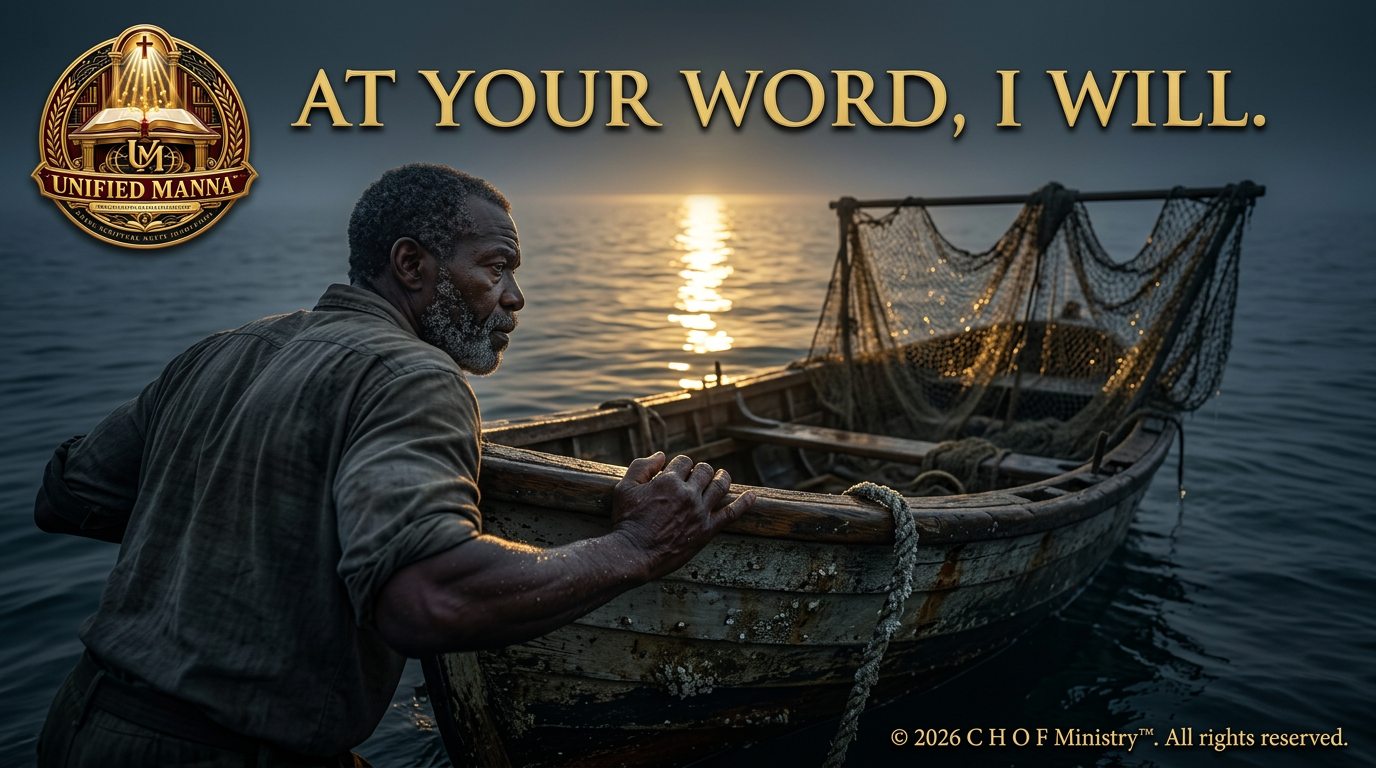
At Your Word, I Will
Surrender is incomplete until Christ’s instruction becomes the disciple’s movement.

FOUNDATIONAL SCRIPTURE · ESV
“And Simon answered, ‘Master, we toiled all night and took nothing! But at your word I will let down the nets.’”Luke 5:5 (ESV)
WISDOM WHISPERS™
“Faith does not keep editing the instruction after God has finished speaking.”— Bishop W. F. Houston Jr.
Word StudyA spoken word, utterance, or specifically expressed instruction. Peter did not launch because conditions had improved. He launched because Christ had spoken, placing divine authority above the evidence of his experience.
THE DEVOTION
Monday confronted the self that insists upon remaining at the center of God’s equation. Thursday asks the unavoidable question: Once you have moved yourself out of God’s way, will you obey what He says?
Peter was not inexperienced, lazy, or unprepared. He had worked through the night and possessed an empty net to prove it. His exhaustion was real. His disappointment was justified. His professional knowledge told him that another attempt would produce the same result. Then Jesus spoke.
Peter did not pretend the previous night had been successful. He placed Christ’s authority above the evidence of his experience: ‘But at your word I will let down the nets.’ That sentence is the language of mature faith. Peter acknowledged what had happened without allowing what had happened to govern what he would do next.
The Greek word rhēma means a spoken word, utterance, or specifically expressed instruction. Peter did not launch because conditions had improved. He launched because Christ had spoken. The authority was not in Peter’s confidence, the weather, the water, or the equipment. The authority rested in the word of Jesus.
Sugar-Free truth: Some believers are not waiting on God. God is waiting on their obedience. We request another sign, another confirmation, another prophecy, and another conversation because obedience would require us to move while the evidence still appears unfavorable. We call it discernment, but sometimes it is fear attempting to sound spiritual.
God’s instruction does not always arrive with an explanation. Faithfulness means obeying what is clear while trusting God with what remains concealed. Monday, self had to decrease. Thursday, obedience must move.
Stop recalculating what Christ has already settled. Stop allowing yesterday’s empty net to overrule today’s divine instruction. Your experience may explain your hesitation, but it does not possess the authority to cancel God’s direction.
The defining words of this season must become: ‘At Your word, I will.’
PERSONAL EXAMINATION
FAITHFUL RESPONSE
Study the evidence
Read the surrounding argument before drawing an application. Scripture links open in a new tab.
Practice interpreting before teaching
- Observe: identify the speaker, audience, situation, and two statements the passage makes explicitly.
- Interpret: state the conclusion in your own words and explain which details support it. Mark any inference.
- Compare: give a reasonable alternative reading fairly. Explain why the context supports or weakens it.
- Apply: propose one present-day response. Identify what the passage does not promise and whose circumstances require care.
- Revise: check the title, illustration, prayer, and assignment against the same evidence. Change any statement that exceeds it.
A strong response names evidence, handles an objection fairly, and distinguishes application from the passage’s direct statement. Agreement with a teacher alone is not a demonstration of understanding.
Published commitments, teacher exercises, and revision record →
Let Us Go Into The Throne Room Of Grace And Mercy.
Prayer
BENEDICTION