
C H O F Ministry — Unified Manna™: Where Scripture Meets Innovation
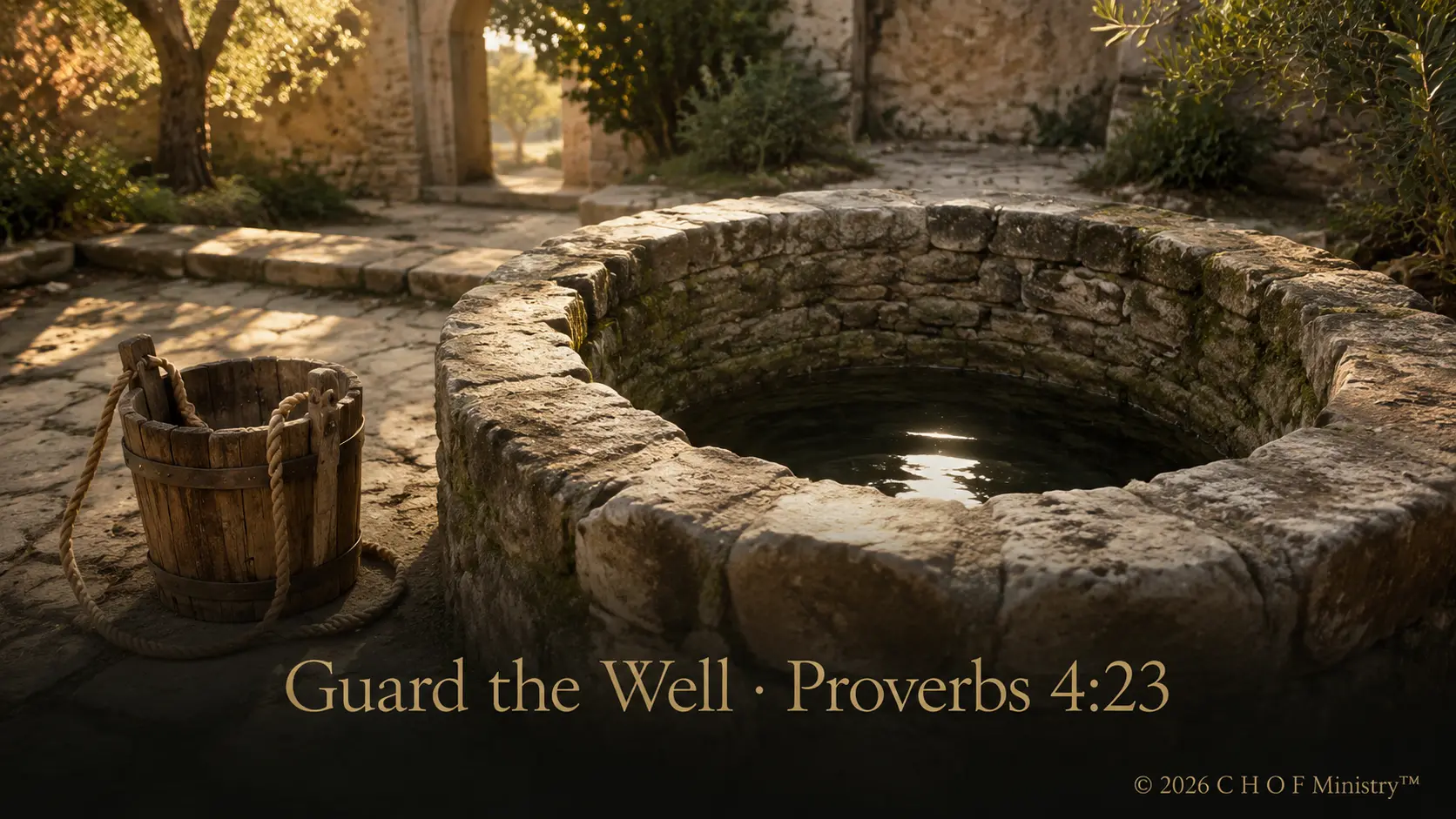
You Cannot Pour From a Poisoned Well
The mouth is only the faucet. If poison keeps coming out, stop wiping the spout and go to the well.

Corrected the Hebrew noun and restored the surrounding commands about words and actions.
About editions and corrections →FOUNDATIONAL SCRIPTURE · ESV
“Keep your heart with all vigilance, for from it flow the springs of life.”Proverbs 4:23 (ESV)
WISDOM WHISPERS™
“The mouth is only the faucet. If poison keeps coming out, stop wiping the spout and go to the well.”— Bishop W. F. Houston Jr.
Word Studyan outgoing or issue; used in the plural in Proverbs 4:23 for the outgoings of life. The surrounding instructions join inward vigilance with disciplined speech and conduct.
THE DEVOTION
Proverbs 4:23 calls for vigilance over the heart, because from it come the outgoings of life. The noun is totsa’ah, appearing in the plural here. The surrounding verses also address speech, sight, and the path of one’s feet. Guarding the heart therefore belongs with care for words and actions; it does not replace them.
This is the discipline most people skip. They want to manage the fruit while ignoring the root. 💧 They apologize for the harsh word without ever asking why the bitterness was sitting in the well to begin with. But you cannot pour clean water from a poisoned spring. Whatever is in the source will eventually surface in the stream.
Notice the intensity Solomon demands — 'with all vigilance,' with everything you have. The heart is not guarded casually. It is guarded like a fortress under siege, because everything downstream depends on the purity of what is upstream. Your relationships, your speech, your decisions — all of them are simply the well showing its water.
So stop trying to fix your words while ignoring your heart. 🙏🏿 The mouth is only the faucet. If poison keeps coming out, go to the well. Guard the source with everything you have — because you will only ever pour what you first stored.
Study the evidence
Read the surrounding argument before drawing an application. Scripture links open in a new tab.
Practice interpreting before teaching
- Observe: identify the speaker, audience, situation, and two statements the passage makes explicitly.
- Interpret: state the conclusion in your own words and explain which details support it. Mark any inference.
- Compare: give a reasonable alternative reading fairly. Explain why the context supports or weakens it.
- Apply: propose one present-day response. Identify what the passage does not promise and whose circumstances require care.
- Revise: check the title, illustration, prayer, and assignment against the same evidence. Change any statement that exceeds it.
A strong response names evidence, handles an objection fairly, and distinguishes application from the passage’s direct statement. Agreement with a teacher alone is not a demonstration of understanding.
Published commitments, teacher exercises, and revision record →
Let Us Go Into The Throne Room Of Grace And Mercy.